


Glass Sponges
Description
This section is from "Scientific American Vol. XL. No. 13. March 29, 1879", by Munn & Co. Also available from Amazon: Scientific American Science Desk Reference.
Glass Sponges
The natural history of sponges had, up to the middle of this century, been comparatively neglected. Until 1856, when Lieberkuhn published his treatise on sponges, very little or nothing had been written on the subject. Later, Haeckel did much to determine their exact nature, and it is now universally admitted that sponges form one of the connecting links between the animal and the vegetable kingdom.
Sponges, generally considered, consist of fine porous tissue, covered, during life, with viscid, semi-liquid protoplasm, and are held in shape and strengthened by a more or less rigid skeleton, consisting chiefly of lime or silica. The tissue consists of a very fine network of threads, formed probably by gradual solidification of the threads of protoplasm. The inorganic skeleton is formed by larger and smaller crystals and crystalline threads. In the various families of sponges the quantity of inorganic matter varies greatly; some sponges are nearly devoid of an inorganic skeleton, while other families consist chiefly of lime or silica, the organic tissue being only rudimentarily developed.
As observed in their natural state, sponges are apparently lifeless. When, however, a live sponge is placed in water containing some finely powdered pigment in suspension, it will be noticed that in regular, short intervals water is absorbed through the pores of the tissue and ejected again through larger openings, which are called "osculae." Following up these into the interior, we find them divided into numerous branches, the walls of which are, under the microscope, found to be covered with minute cells, fastened at one end only and oscillating continually. By means of these cells the sponge receives its nourishment.
Sponges with very rigid inorganic skeletons may be divided into two classes - calcareous and silicious - according to whether the skeleton is chiefly composed of lime or silica.
Our engravings represent two species of the latter kind, which are, on account of the peculiar appearance of their skeleton, called glass sponges.
Fig. 1 represents the "sprinkling pot sponge,"Eucleptella aspergillum. It is generally found in very deep water throughout the Pacific. Specimens were found over fifty years ago, but, as they had to be brought up from depths between 500 and 800 fathoms, they remained very scarce and sold at fabulous prices.

Fig. 1. - SPRINKLING POT SPONGE. - (Eucleptella aspergillum.)
The skeleton is formed by small crystals and long threads of vitreous silica, cemented together, during life, by protoplasm. They are arranged in longitudinal and annular bands so as to form a long curved cylinder, about nine to twelve inches long, the walls of which are about one inch in thickness. The threads and bands are interwoven with the greatest regularity, and when the skeleton is freed from the adhering organic matter, it looks extremely beautiful.
The mode in which the intersecting bunches of crystals are connected is shown in Fig. 2. The upper end of the cylinder is closed by a perforated cover, which probably has given rise to the name of the sponge. The upper portion of the cylinder is surrounded by a few irregular, annular masses of organic tissue, which adheres loosely only to the skeleton. The lower end is formed by a bunch of long threads, rooting firmly in the ground.

Fig. 2. - SPONGE CRYSTALS MAGNIFIED.
Up to about ten years ago the price of specimens of this sponge was very high. At that time, however, a colony of Eucleptellas was found near the cities of Cebu and Manila, in the East Indies, in a depth not exceeding 100 fathoms, and since they have appeared in larger quantities in the market. It is remarkable that, contrary to their habits, these organisms have immigrated into regions to which they were totally unaccustomed. Yet it must be regarded as a greater curiosity that they have been accompanied to their new abode by a few animals living in equally deep water and never met with before at depths less than three or four hundred fathoms. Among these animals is aPhormosoma(water hedgehog), noted for its long spines.
Glass sponges are not confined to tropical regions. They are met with in latitudes as high as the Färöe Islands, where the beautifulHoltenia Carpentariaabounds. It is represented in Fig. 3. Its cup-shaped skeleton is similar in structure to that of theEucleptella; numerous crystalline needles protrude from the surface of the upper part. Lately some specimens ofHolteniahave been found on the coast of Florida.
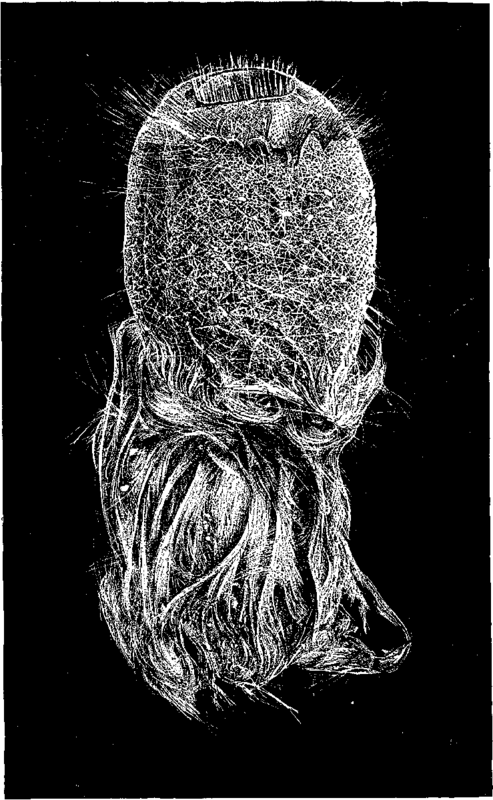
Fig. 3. - HOLTENIA CARPENTERIA.
Glass sponges serve as dwellings for numerous animals, especially crustaceae. A small shrimp inhabits the tubes of theEucleptella, a male and a female generally living together. They are shut up as in a prison in their crystalline home, as they are generally too large to pass through the meshes formed by the bundles of crystals. It was formerly believed that these skeletons had actually been built by the shrimps, and we can find no explanation for this curious circumstance, other than that the shrimps entered these habitations while very small and became too large to leave them.
Continue to:


My Books

