


Piston-Rod Glands
Description
This section is from the book "Wrinkles And Recipes, Compiled From The Scientific American", by Park Benjamin. Also available from Amazon: Wrinkles and Recipes, Compiled From The Scientific American.
Piston-Rod Glands
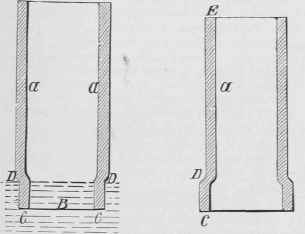
If these are rather tight, the piston-rod may be eased by rubbing the gland up and down the rod, and giving it at the same time a revolving motion back and forth at each stroke. Oil must be supplied to the rod to prevent the gland from seizing or cutting. A gland should be chucked in the lathe by the flange, so that the bore and outside diameter may be turned at one chucking, and thus be true without depending upon the truth of a mandrel.
Plaster, Inserting screws in-Make a large hole in the plaster and drive in a wooden plug, in which insert the screw. The plug may be first split and a groove cut in each half.
PulleYs, Turning-Pullevs should be turned either on a man-drel, or else chucked by the arms, since chucking them by the rims springs them out of true.
Punching Metals-The same elements of resistance enter into the operation of punching as in that of shearing. In short, a punch and die may be considered as shears with circular blades. The coefficient of pressure in punching, for any given area of section, will be exactly that for shearing the same area of section, without reference to the thickness of the material. The measure of force necessary to effect the various punchings readily gives the value of the resistance to shearing in cases of ordinary metals. This resistance, per square foot, is determined to be, in lbs.: For lead. 392, 548: block-tin, 450, 784: alloy of lead and tin, 731, 176; zinc, 1, 843, 136; copper, 4, 082, 941; iron, 103, -333.
Shrinking Metal-Works
Continue to:


My Books

