


How To Lay Out Quarter-Twist Belts
Description
This section is from the book "Wrinkles And Recipes, Compiled From The Scientific American", by Park Benjamin. Also available from Amazon: Wrinkles and Recipes, Compiled From The Scientific American.
How To Lay Out Quarter-Twist Belts
To make holes through floors for the belts, lay out on a floor with chalk-line and train two views of the pulley, or by scale on paper as shown in the annexed diagram. B is the belt running in the direction of the arrow on the lower pulley, and C is the belt running in the opposite direction. Therefore, drop a plumb-line, representing the perpendiculars, B and C, and draw the diagonals governed by the diameters of the pulleys, marking the distances a b and c d on the floor. Now, drop a plumb-line from each side of the centre of face of upper pulley to the floor, and from one point, c, thus found, lay off the distance a b, in a line parallel with the upper shaft, and from the point a in the distance, c d, parallel with the Lower shaft. These points are the places at which the holes should be- cut.
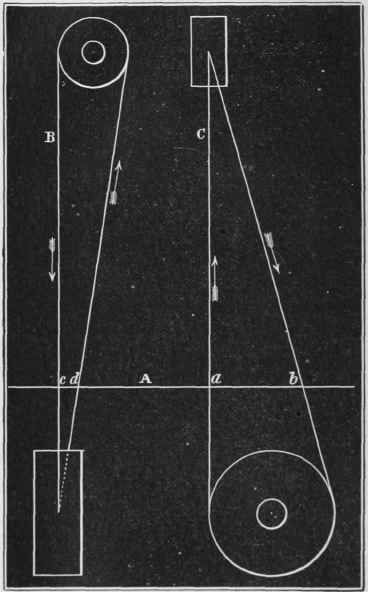
Laying Out Quarter-Twist Belts Through Floor
Friction And Lubricants- Whenever one surface moves upon another, the rough and projecting points of the two surfaces (which always exist, even in the smoothest surfaces) op pose resistance to the motion, and this resistance is called fric-tion.
The coefficient of friction is a quantity expressing the ratio of the friction to the pressure. For instance, if the resistance to moving one piece of metal on another is one fifth of the weight of the moving body, the coefficient of friction in this case is one fifth, or 0.2. Hence, knowing the coefficient of friction, in any given instance, and the weight of the body causing the resistance, the amount of friction is found by multiplying these two quantities together.
The work due to or lost on account of friction, in any given time, is found by multiplying the amount of friction of the moving body by the space passed through in the given time. It is customary to estimate the amount of friction in pounds, to make the given time one minute, and to measure the distance passed through in that time in feet. The result obtained will then express the number of foot-pounds of work performed per minute in overcoming friction, and this can readily be reduced to horsepower, or any other desired unit of work. It is important to maintain the distinction between the amount of friction and the work of friction.
The experiments of Coulomb and Morin have demonstrated the following facts in regard to friction:
That it is proportional to the pressure.
With some limitations, that it is independent of the area of the surface pressed, and independent of the velocity of motion.
The limitations are, that the pressure should not be so great as to abrade or wear away the surface rapidly, in which case the friction does not follow the laws enunciated above; also, that the velocity of motion shall not be so great as to expel the lubricant. It is found, for instance, in the case of the journals of car-axles, that they require to be enlarged as the speed increases, in order to prevent the expulsion of the lubricant. The actual bearing surface of a journal is usually considered to be the projected area of that journal, or the product of the length multiplied by the diameter. For instance, if a journal is 4 inches in diameter and 7 inches long, the bearing surface is 28 square inches.
Continue to:


My Books

