


Trellises And Ornamental Garden Fences
Description
This section is from the book "Things To Make In Your Home Workshop", by Arthur Wakeling. Also available from Amazon: Things to Make in Your Home Workshop.
Trellises And Ornamental Garden Fences
Trellises and fences in unlimited variety may be made by any handy man or boy. And the most artistic are often the least expensive to construct, because their beauty lies in their proportions and design, their simplicity and appropriateness, rather than their size and elaboration. Indeed, if the work is planned early enough, many odd bits of excellent materials may be salvaged from the kindling pile or may be obtained from the waste and cuttings about a new building.
Nothing adds so much to the general appearance of the average garden or lawn as a well-designed trellis or a small fence (Fig. 37). Artificial supports are always pleasing if carefully planned and wisely placed, and a clean white fence gives an air of seclusion wherever that is desirable on account of unattractive surroundings. In the small home garden where space is at a premium, the trellis or fence should serve at least two purposes - a support for climbing vines and tall shrubs and a useful screen for some portion of the garden.
Materials best suited for this work are pine, cypress, western cedar, and fir; however, any wood that will withstand the sun and rain without checking too much or twisting out of shape will serve the purpose.
All commercial lumberyards have stock suitable for the construction of these trellises. Two of the more common sizes are 3/8 by 1 3/8 in. and ¾ by 1¾ in., otherwise known nominally as ½ by 1½ in. and 1 by 2 in. These stock sizes may be purchased surfaced on four sides and ready to cut into lengths. Many sizes, both larger and smaller, can be obtained and often are desirable.
In the case of the trellis shown at A in Fig. 38, for example, the stock used is ¾ by ¾ in., of which 26 ft. are necessary, as well as a piece of ¾ by 6 by 14 in. for the brackets. It is put together with half lap joints, although thin, flat strips might be used and a plain nailed joint substituted for the half lap. The half lap joint is not difficult to make and adds much to the attractiveness and solidity of the trellis.
The most important thing in cutting a half lap joint is to have it laid out accurately to start with. In constructing the trellis at A, all the parts should be cut. to size and laid on the floor in the positions they will have after the joints have been cut. A few small brads may be driven through the members to hold them firmly in place while the joints and angles are being laid out. "When cutting the joints it is best to saw on the inside of the lines so that a very tight fit may be obtained. If too tight, the extra stock may be gradually trimmed away.
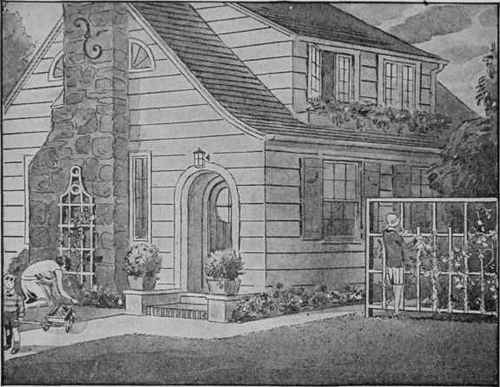
Fig. 37. - Well-designed trellises and fences and adequate planting enhance the beauty of any home, whether the architecture itself is plain or ornate.
The two brackets can be laid out full size with the aid of the 1-in. squares as shown at F. Note that the two shapes are suggested, one 6 by 7 in. over-all and the other, 6 by 9 in.; cither may be used. Two can be cut from a piece 6 by 14 in. by laying them out in the most economical way; that is, one within the other like two reversed and interlocking C's. The pieces are sawed with the aid of a compass saw, turning saw. or fret saw; or the drawing can be taken to a cabinet shop where for a small amount the cutting will be done on a band saw.
Wooden barrel hoops are sometimes used effectively to make curved parts of trellises.
In the trellis shown at B it will be seen that a variation of the half lap joint has been indicated; if this type of construction is used, a very strong joint will be the result. The curved braces or brackets are the same size and shape as those used in the first trellis. The material necessary is 24 ft. of ¾ by ¾ in. stock and one piece ¾ by 6 by 14 in. Other designs are suggested at C and D; indeed, the possibilities are endless. For the design at C it is necessary to have 17 ft. of % by 1% in. stock and a piece % by 4 by 8 in. for the semicircular top, if used. For that at D the materials are 35 ft, of ¾ by 1½ (or 1¾) in. stock and one piece ¾ by 12 in. by 3 ft. 6 in. for cutting curves and rings.
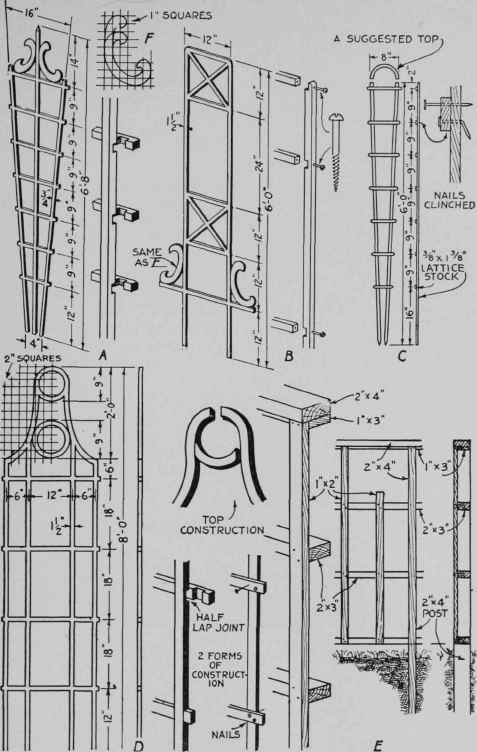
Fig. 38. - Various trellis designs suggested for home craftsmen. These can be modified in countless ways.
What has been said of the construction of trellises and supports is also true of making simple fences. Figure 38 at E shows a relatively light and inexpensive design. Some very interesting patterns may be worked out in the building of these fences, as is shown in Fig. 39.
It will be understood, of course, that the dimensions given are merely suggestions; the designs can be worked out in various sizes and many different ways. The amateur's tendency perhaps is to err on the light side. Fences are exposed to considerable stress and strain, especially in the northern states where winters are severe and there is much ice and snow. It is astonishing how even 1 by 2 in. stock will sag under the pressure of high snow drifts and ice crusts.
When a fence is low and quite long and the cost must be kept at a minimum, it is sometimes possible to work out a satisfactory design by using ordinary plasterer's lath instead of lattice strips, although the fact that laths are not smoothed renders them rather difficult to finish with paint.
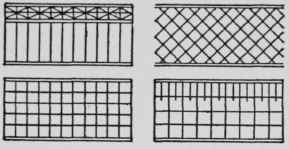
Fig. 39. - Four methods of making light, decorative fences to serve as vine supports and screens.
The setting or putting into place of a trellis, fence, or other garden fixture is quite important. If it is placed carelessly in the ground and the earth is not tamped firmly, it will soon sag and lean.
A good method of setting up the ordinary trellis is to place a post exactly under where the trellis is to stand. Sink it at least 18 in. deep. This post should be tamped in place and sawed off so that about 6 in. of it extends above the surface. To this protruding end may be attached the trellis with either nails or screws. If desired, the post may be set in concrete, and a more stable and rigid construction thus obtained.
In the case of fences, small split 2 by 4 in. or 4 by 4 in. posts may be used. These should be sunk in the ground an ample distance to insure solidity, and preferably well below the frost line.
Some method of finishing garden furnishings is necessary because the surface of the wood must be protected from the sun and the rain or decay soon begins. Either stain or paint may be used, but paint has the greater protective value. White, cream, brown, or green are the colors ordinarily used, all of which look well and attractive in a garden setting.

Fig. 40. - Concrete garden benches of this type are useful and ornamental, yet they are not difficult to make and are relatively inexpensive.
If paint is used, apply not less than three coats, the first of which should be well thinned with linseed oil. If stain is used, one coat of a high grade oil stain for outdoor use will always serve the purpose very well.
Continue to:


My Books

