


Kitchen Table Bench
Description
This section is from the book "Things To Make In Your Home Workshop", by Arthur Wakeling. Also available from Amazon: Things to Make in Your Home Workshop.
Kitchen Table Bench
Such a bench top consists chiefly of a piece of plank 2 by 12 in. and about 8 in. longer than the length of the table top. Southern pine, Douglas fir, cypress or any other soft wood that is not too expensive is satisfactory for this. It is advisable to get the best grade available and to insist that the piece be dry in order to prevent warpage. If it is ordered surfaced on four sides (S4S), its dimensions will be 1% by about 11 in., which is satisfactory. The exact size, however, is of no especial importance.
This plank is fastened to the table with two large C-clamps, one at each end, so placed as to be out of the way as much as possible. It is well to screw two cleats across the board on the underside, spaced so as to fit snugly against the ends of the table top. These take much of the strain from the C-clamps when planing or similar work is being done.

Fig. 1. - Bench top with quick-acting woodworking vise for use on a kitchen table. The top is fastened on the table with heavy C-clamps.
For the simplest arrangement, two hand screws will form an inexpensive and satisfactory substitute for a regular vise. This expedient, which is illustrated in three views on this page, keeps the top piece clear of cumbersome permanent attachments and makes it easier to store in a small space when not in use. In addition, the hand screws are of frequent use in clamping together work that has been glued, especially furniture.
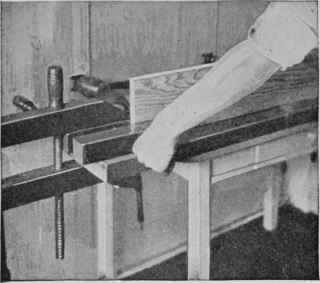
Fig. 2. - Using two hand screws as a substitute for a vise.

Fig. 3. - How the hand screws are placed on the kitchen table bench for planing wide boards.
Figure 2 shows how the hand screws are applied to the top surface of the bench for planing the edges of boards that are not too wide to be supported in this way.
For wider boards, the screws are placed so that the inner jaw of the horizontal one comes even with the edge of the bench (Fig. 3). Used in this way, the hand screws serve much like the ordinary vise. If the boards to be planed are long, the free end must have some means for support; suggestions for providing this will be given later. When attached as illustrated in Fig. 4, the improvised vise serves well for ripping because the saw can be run down past the level of the bench.
A bench stop made of wood will prove quite satisfactory for this type of bench. Such a stop will also help to keep down the cost to a minimum. It can be made by the common method of sawing a V-shaped cut in one end of a piece of wood and nailing it on the bench at the left-hand end.
A little more time and effort will produce a more satisfactory stop as shown in Fig. 5. This stop is made from three pieces of hardwood ¾ by 1¾ by 6 in.

Fig. 4. - This method of attaching the hand screws is a useful one when boards are to be ripped.
One edge of each of the two wedge-shaped pieces is beveled to prevent the clamping piece from rising when pressure is applied. If enough taper is put on the pieces, the stop will grip stock varying in thickness from ¼ to 1½ in.
Many a home worker undoubtedly will wish to increase the possibilities of this outfit by using a metal stop and a small metal vise. Both of these usually may be obtained at the hardware store. If not, they can be had on special order.
There are several excellent types of stops available, but the kind that is adjusted with a screw driver is preferred by many because it stays "put." To fit in such a stop, first bore a hole large enough to allow the bar to move freely. Then place the stop in position and mark around the horizontal surface with a knife or awl. The cutting is completed with a chisel, until the top of the plate lies flush with the bench top. The stop is fastened with screws as illustrated in Fig. 6.
The rapid-acting type of vise probably is preferable for a small bench. It may be only 4 in. in length, but one with 6-in. jaws will prove more satisfactory in the long run. These vises are made for tops of 2¼-in. thickness, so for this job it is necessary to build up the thickness by using a ¾-in. piece of wood as a filler.

Fig. 5 (at left). - A homemade wooden stop for planing. Fig. 6 (center). - Fastening an iron stop in place. Fig. 7 (at right). - How a rapid-acting vise is fitted. The same vise is shown in use in Fig. 1.
To fit the vise in place, turn the plank over as shown in Fig. 7. Detach the free jaw of the vise temporarily for convenience in working; then fit the stationary part to the top. Cut back in the edge of the top for the thickness of the jaw, and also make allowance for screwing a thin piece of wood to each of the inside surfaces of the jaws to prevent marring the work.
If an "apron" piece is to be used to hold up long boards as shown in Figs. 1 and 8, the thickness of it must be taken into account so that it will come flush with the jaw of the vise. Such an apron can be nailed to the edge of the plank or under the edge, according to the construction decided upon; the former is the easier method.
A substitute for a vise that is sometimes used is a block about 1% by 3 by 8 in., which is cut on a long bevel for 3 or 4 in. on one of the flat faces and screwed against the upper left-hand corner of the apron in such a way that the beveled part forms a V-notch into which one end of a board may be pushed when it is to be planed. The board is further supported by two pins inserted into holes in the apron.
When thin stock is to be planed on the surface and you have not fitted a regulation bench stop, you can nail a strip of wood temporarily across the face of the bench board to act as a stop. If you prefer, you can make a removable stop by nailing or screwing a block ¾i by1 ½ by 4 in. across one end of a thin piece of hardwood ¼ by 4 by 12 in. To use this stop, the block at the end is gripped in the vise in such a way that the thin board lies flat across the bench top.
To do smooth surface planing, it is important that the table be rigid. It can be braced by cutting a stick of wood to reach diagonally from under the left end of the bench top to the juncture of the floor and wall of the kitchen or to any convenient stop on the floor. This brace will resist the tendency of the table to sway when the plane is pushed forward.

Fig. 8. - One form of portable bench top with an apron, a quick-acting vise, and an adjustable planing stop.
Because of the bulkiness for storage, it may be better in some cases to omit the apron and use instead a special support constructed like an old-fashioned window stick, having a number of notches to suit boards of various widths.
The completed top with metal stop and vise and with an apron containing a series of holes for supporting long boards is shown in Figs. 1 and 8. With such a convenience the handy man is not prohibited from doing small jobs in repair and construction even though modern civilization has forced him into restricted quarters in which to work.
Continue to:


My Books

