


An Occasional Table
Description
This section is from the book "Amateur Work Magazine Vol4". Also available from Amazon: Amateur Work.
An Occasional Table
John F. Adams
Small tables are always in demand for various uses, and the one here described will be found very serviceable in hall, library or chamber. The wood used for constructing it should be finished to correspond with the other furniture in the room where it is to be placed.
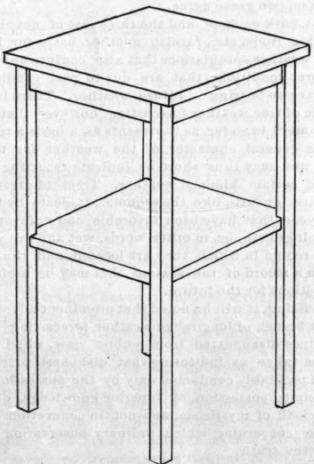
The top is 15 in. square and 7/8 in. thick, of one piece, if possible. It should be of well seasoned stock to avoid subsequent warping, and planed smooth and level. The legs are l 1/2 in. square, and 29 in. long. Mortises | in. wide, | in. deep and 2 in. long are cut at the top ends to receive tenons on cross-pieces under the top, which are 11 1/4 in. long, 2 in. wide and 3/8 in. thick, allowing 3/4 in. on each end for tenons. The fitting of these cross-pieces should be very accurately done, otherwise the table will not be firm. The joints are glued and pinned with 3-16 in. dowels. In boring the holes for the dowels be careful not to split the wood.
The top is attached to the cross-pieces by screws put through from the under side. First bore 1/2 in. holes, two in each cross-piece, to a depth of about 1 1/2 in., then following with a gimlet bit, a trifle larger than the screw. By placing the top of the table on the floor, with the under side up, and then placing the frame on top, first having marked lines to show the proper position, the holes in the top can be bored and the screws then put in so they will hold very securely.
The under shelf is 12 1/2 in. square and 3/4 in. thick, 1 in. square being cut out of each corner to fit around the legs. It is well to wait until the frame is made, however, before cutting out the corners, so that any little inaccuracies of fitting may be allowed for. The The under shelf is attached to the legs by screws cornered in from the under side, countersinking for the heads and using a long screw of not very large gauge.
Multiply the number of volts of a storage battery by the amperes, and you will have the number of watts. Divide the watts by 746 and you have the horsepower. From 20 to 40 per cent of the energy developed by the battery will be lost in converting it into power in a motor, the remainder being available for use in the form of power.
Continue to:


My Books

