


A Simple Electric Motor
Description
This section is from the book "Amateur Work Magazine Vol4". Also available from Amazon: Amateur Work.
A Simple Electric Motor
Albert G. Warren
The accompanying illustration shows a simple type of electro-motor suitable for driving small models, boats and cars or for rotating color discs. Under no circumstances must it be expected to do work requiring more power than that derived from the ordinary types sold for about a dollar, yet if well made it will run well on one cell of any kind of battery, and at a high speed when more cells are added.
The magnets may be cast in soft iron from a wooden pattern, or forged into shape from a strip of iron 1/8 in. thick and 3/4 in. to 1 in. wide. Each magnet is 2 1/2 in. long, and the space between poles is 1 1/2 in. One of the magnets is to be fastened permanently to the wooden surport, and the other is fastened to a shaft of 1/8 in. steel. This shaft fits evenly into 1/8 holes drilled into small machine screws which serve for bearings. One screw is shown in the illustration, and the second projects through the center of the fixed magnet. A two-part commutator, of a design so familiar to all amateurs that it need not be described here, is affixed to the shaft, as is also a small wooden pulley turned to any size convenient for the maker. The two magnets are wound each to have north and south poles like any horseshoe magnet. The wire should be about No. 22.
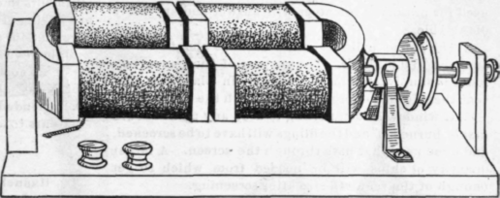
The rotating magnet is placed in position before the fixed magnet with just enough space between the poles so as not to interfere when in motion.
One of the ends of the wire coming from the fixed magnet goes to a battery binding post. The other is carried to one of the brushes. The other brush is connected the remaining battery terminal. Each of the revolvin magnet terminals is connected with a segment of the commutator. All bearings should be well oiled and the shaft adjusted so as to turn freely.
Continue to:


My Books

