


Electric Alarm For Clock
Description
This section is from the book "Amateur Work Magazine Vol3". Also available from Amazon: Amateur Work.
Electric Alarm For Clock
E. A. White
It will undoubtedly interest some of the readers of this magazine to know how to arrange an alarm clock so that it will close an electric circuit at the time at which the alarm is set to ring, and by this means sounding an electric bell in place of the alarm on the clock. A piece of pure copper wire of No. 14 or 16 gauge, about 4 in. long, and a piece of adhesive tape about 2 in. long are required, as well as a dry battery and common electric bell. Unscrew thering i from the top of the clock and remove the gong, then replace the ring. Wind the piece of copper wire g two or three turns around the post, after covering the latter with adhesive tape, and twist the ends together so as to hold the wire and tape securely. Bend one or the free ends into a hook, to which attach a wire from the battery, and bend the other free end in the opposite direction so that it will engage the hammer that strikes the gong when the hammer moves.
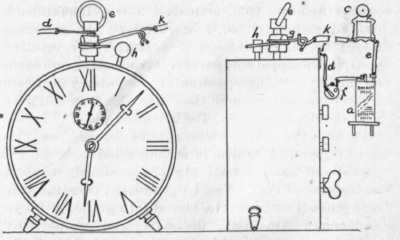
If the clock is to stand on a shelf, connection is made from the switch f to the clock itself by placing the clock on a piece of sheet tin or brass to which the wire d is fastened, or by fastening this wire to the ring i at the top of the clock.
Put the battery and bell in a convenient place, and if the arrangement is to wake one up in the morning the switch f should be placed on the wall within reach of the bed. The writer has a nail driven in the wall near the bed on which the clock is hung by the small ring on the upper part of the back b and around which the wire d is wound. This makes contact with the clock itself, and when the clock is to be wound up it is only necessary to unhook the wire e and take the clock off the nail j. The switch f is placed beside the clock. The writer also has a switch placed on the wall beside to the other, a process which practically insures a double amount of strength at the joint.
the switch / so that by reaching out ot bed and turning the switch the electric light in the room is turned on. The face of the clock can then be seen, being so near the bed.
The connections are as follows: One pole of the battery a is connected by the wire b with the bell c and another wire, k connects the bell with the switch f; the end of the wire d from this switch is then made in the shape of a hook and can be easily hooked and unhooked to the wire g on the clock. The other pole of the battery a is connected to the ring i on the top of the clock, to the nail/ on the wall or to the piece of tin on the 6helf, according to the method followed in making connection with the metal part of the clock.
We will now suppose that it is desired to ring the bell at six o'clock. The alarm and time springs of the clock are wound up, the alarm hand set at the figure 6 and the switch f closed. When it is six o'clock the trigger, or hammer h, on the clock will spring forward and stay against the wire g, held by the alarm spring of the clock. This makes contact from the metal part of the clock to the wire g through the hammer h.
The circuit is thus completed and the bell will ring until the switch f is opened. To set the clock to ring again the hammer h is pulled back (it will not stay until about half an hour after the alarm has gone off) out of contact with the wire g and the switch f closed. Other apparatus instead of the bell may be operated at a certain time by means of the clock, by substituting that apparatus in place of the bell. The writer has used this arrangement for a long time to ring a bell and awaken him in the morning.
Continue to:


My Books

