


A Telegraph Recorder
Description
This section is from the book "Amateur Work Magazine Vol3". Also available from Amazon: Amateur Work.
A Telegraph Recorder
Frederick A. Draper.
Until one has acquired the ability to read telegraphic sounds by ear, some form of recording instrument is necessary to enable messages to be received. The apparatus here described is easily made at small expense, and with it the messages are legibly printed upon the moving tape and can, therefore, be read as soon as the operator has memorized the various characters.
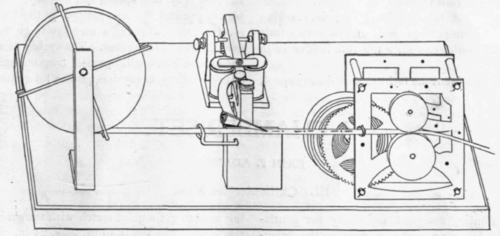
The illustration shows the general arrangement ; the works from an old clock provide the mechanism for moving the tape, a common sounder is fitted with a smaff pen of the kind used for paper ruling machines, the point of which rests on the tape and marks it, the tape being supported under the pen by a small, smooth block of wood. The tape, the kind used in "ticker" machines to be found in stock brokei's' offices, is supported by a frame and should unroll with but little friction. These parts are all arranged on a suitable baseboard, the size being determined by that of the parts used for making the receiver.
The works of the clock can frequently be had for the asking at a jewelry store. The requirements are : a strong spring in good working order, and the train of the four gears, that on the spring shaft being the first. The escapement and alarm part are removed. The hour hand^shaft will be found to project from about the centre, and about 1 in. above will be found the shaft for the trip of the alarm. The latter is removed and a shaft projecting about 1 in. is fitted in its place. To the hour-hand shaft and the shaft just mentioned are fitted two wooden pulleys or cylinders, that on the hour-hand shaft being the larger, and covered with a wide rubber band. The upper pulley is of a size to fit firmly against the rubber covering on the lower one, so that the tape, which passes between them, will have a firm and even tension. A wire is bent to form a guide for the tape, and fitted to the clock frame.
For attaching the pen to the sounder, a support is made of thin, strip brass, which may be cut from the clock case, the inner end being curved to come under the check nut on the adjusting screw of the armature lever. The outer end is curved to a V shape and at an angle, so that it will hold the ruling pen firmly and at an angle sufficient to cause the ink to flow readily. A block of wood is glued to the base board under the point of the pen, to support the tape, the size being determined after the pen is in position. A wire guide for the tape is also fitted to this block, as shown in the illustration.
The bracket for the tape holder can be made by mortising the end of a piece of wood in the base board, or a 6 in. angle iron may be used, a part of one end being cut off. The tape mentioned comes in rolls 5 in. diameter, with a wooden block in the centre 1 1/8 in. diameter, the tape being 11/16 in. wide. Other sizes are sold by wholesale paper houses, and the parts should be made for the size of rolls most easily obtained.
To the top of the bracket fit a 1/4 in. machine screw long enough to project and allow two nuts to go on the outer end after the roll holder is in place.
The roll holder is made from an ordinary spool, the flanges being cut off and the length being 1/4 in. greater than the width of the tape. On one end drill four holes to receive wires about 2 1/2 in. long; the holes should be a driving fit for the wires. Then cut a disc the same diameter as the spool, from a piece of 1/4 in. wood, first boring a hole in the centre slightly larger than the machine screw bearing. Fit four wires to this disc, the same as with the spool. The roll of tape being placed on the holder, the disc is placed outside, and after putting it on the shaft the nuts are put on, the outer one acting as the check nut to prevent the inner one from binding on the disc and spool, and so holding them in place and yet allowing them to turn freely.
When all is completed the tape is carried from the holder under the pen and between the two pulleys of the clock works, the latter wound up and, when desired, allowed to pull the tape under the pen. The illustration does not show all the gears. The fourth one projects at the side so that a trip can be fitted to it, which can be moved by an electric magnet in series with the sounder. In this way the spring can be kept constantly wound up, and the tape started by the first signal received, thus allowing a message to be recorded even if no one is present. The spring of an ordinary alarm clock will operate long enough, without rewinding, to receive quite a long message.
Continue to:


My Books

