


The Telescope. Refractor and Reflector. Part 3
Description
This section is from the book "Amateur Work Magazine Vol1". Also available from Amazon: Amateur Work.
The Telescope. Refractor and Reflector. Part 3
The optical glass of which all lenses are made is of two different kinds, called crown and flint glass. The latter has a refractive power slightly greater than that of the crown ; its dispersive power is about three times as much greater as its refractive. Says Dr. Dick: " The edges of the lenses, one of crown and the other of flint glass, may be considered as two prisms which refract contrary ways, and if the excess of refraction in the one be such as precisely to destroy the divergency of color in the other, a colorless image will be formed. Thus if two lenses are made of the same focal length, the one of flint and the other of crown, the length or diameter of the colored image in the first will be to that produced by the crown as three to two nearly. Now if we make the focal lengths of the lenses in this proportion, that is, three to two, the colored spectrum produced by each will be equal." (I am not responsible for the good doctor's English, but his idea is clear enough.) "But if the flint lens be concave, and the crown convex, when placed in contact they will mutually correct each other, and a pencil of white refracted by the compound lens will remain colorless."
It also happens that when the flint and crown lenses are adjusted to best accomplish this result, the spherical aberration is also perfectly corrected, and the convexity of the crown lens is greater than the concavity of the flint to such an amount that the combination is virtually convex, and the rays form an image at its focal point.
This correction, however, is only approximate, though a close approximation, as the extreme rays of the spectrum cannot be brought to absolutely the same focal point by any combination of flint and crown lenes, though an infinity of approximations, all equally close.
is possible; the problem is therefore what is mathematically called an indeterminate one.
In practice the curves are so computed as to bring the rays of greatest light intensity and the extreme rays together, so as only to lose those of least illuminating power.
There is always, therefore, in the achromatic, a fringe of violet light about the image of a bright object in focus. This is called technically the " outstanding light," a term the reader will often meet with in the literature of the telescope, and it is never wholly absent; this causes no difficulty in practice, as the eye very soon becomes accustomed to it, and disregards it, so that we actually do not see it unless we look for it.
The exact curves are different with different makers, each of whom has his favorite "formulas," as an indefinite number of different modifications will all be equally satisfactory in practice.
The early achromatics were very expensive, but in spite of this they made their way, and in a hundred years had practically crowded the reflector out of the field. But, about 1864, Foucault, of Paris, made some specula of glass, coated by an electrolytic process with a film of pure silver, which reflects as much light as an achromatic objective transmits. These specula were very satisfactory.
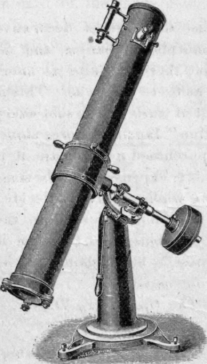
Fig. 7.
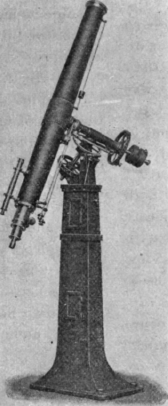
Fig. 9.

Fig. 8.
Since that time the reflector has steadily developed, and is now again a formidable competitor for favor with the refractor. Fig. 7 represents a modern 6i-inch reflector of American make, on a plain stand fitted for general planetary and star-gazing work; price, $250.
Fig. 8 is a three-inch refractor by Clark, on a corresponding stand; price, $150.
The reflector, however, has nearly four times the power of the refractor.
Fig. 9 represents a complete modern six-inch equatorial refractor, with circles, clock, etc. In such an instrument the mounting is often made by one firm, and the optical parts by another. The price of a refractor like this is about $1,500. The corresponding reflector would cost about $650.
Until 1830, a six-inch refractor was a large telescope, and an eight-inch a very large one. The Harvard Observatory fifteen-inch was a monster when made. Later advances in the manufacture of optical glass have extended the possible aperture to the forty inches of the Yerkes telescope, and this is very likely not the limit in this direction ; though from the increasing engineering and other difficulties, this seems to be possibly the limit of useful increase.
The large reflectors of Herschel and Rosse were scarcely more than costly experiments. The Rosse specula were confessedly defective in definition. A
French astronomer, who was shown Saturn with the great six-foot, said: " They showed me something, and said it was Saturn, and I believed them." Dr. Common, in England, however, has made silvered glass specula of three and five feet aperture, for photographic purposes, whose performance is understood to be excellent.
It will be seen that the beginner's choice between the two types is a difficult one, and it becomes more so the more he knows about the matter, as the advantages are pretty evenly divided. One is very likely to become accustomed to his first choice, and prefer it to the other, and to advise other seekers for information according to his prejudices. Either type is good, and the question practically resolves itself in the end into one of personal taste, and length of purse. Vega.
Continue to:


My Books

