


How To Build A Rowboat
Description
This section is from the book "Amateur Work Magazine Vol1". Also available from Amazon: Amateur Work.
How To Build A Rowboat
C. R. Sawyer.
No doubt many of our young friends are looking forward to the coming summer, and some are even planning what they will do. If a boy has a mechanical turn of mind, nothing will give him more enjoyment and satisfaction than to build a boat. The following description will give all the instruction necessary to build a boat 12' long. All the articles required are ten boards 7/8" thick and about 14/ long, two boards 14" wide, 7/8" thick and 13' long, free from knots ; a piece of oak 2' 6" long, 10" wide and 1" thick ; a piece of oak 21/2" thick, 8" wide and 16" long; some galvanized iron nails and some white lead or thick paint.
The first thing to make is the stem. Take the piece of oak 16" long, 8" wide and 21/2" thick, and cut grooves of the shape shown in Fig. 1. This can be easily done with a hacksaw, smoothing over with a rabbet plane, or it may be made of two pieces firmly screwed together.
Then proceed with the piece for the stern (Fig. 2), which is made of oak, 1" thick, 10" wide, cut slanting on the ends, so that the top measures 28" and the bottom 22" long. Make a similar piece of pine for a cross-board, 4' on the top, 3' 6" on the bottom and V wide. For the side boards take the two pieces 14" wide, which should be of pine or cedar and perfectly sound and free from knots, so they will bend evenly. The ends of the side boards should be sawed off like the cross-board, making it 8" shorter on the bottom, as shown in Fig. 3, for the bow. Beginning 4' from the other ends, cut a bevel down to 10" wide ; also bevel on the ends, as shown in Fig. 3. Place the ends of the side boards in the grooves of the stem, have the bottom end of the stem flush with the bottom of the side boards, taking care that the ends fit nicely in the grooves, and screw them securely to the stem with the brass screws. Then place the cross-board about midway between the ends of the two side pieces, with the longest side on the top, as shown in a, Fig. 4, and fasten lightly with nails. With the aid of a rope and a stout stick, draw in the ends of the side piece by twisting the rope until they join the stern board shown at b, and nail securely. Then carefully turn the boat over and plane the bottom edges of the sidepieces so that the bottom will have a flat and smooth bearing. The bottom boards can now be nailed on. All joints should be coated with lead paint before finally fastening together. A bottom board about 8" wide and 7/8" thick should then be placed inside, extending the whole length of the boat, to stiffen the bottom. The nails should be driven from the inside, and the ends turned over. Of course the cross-board will have to be removed before you do this. It will be well to put brackets in the corners where the stern board joins the side boards, as in Fig. 5. A piece of wood can be nailed temporarily across the top edges, to keep the sides in place until the seats are put in.
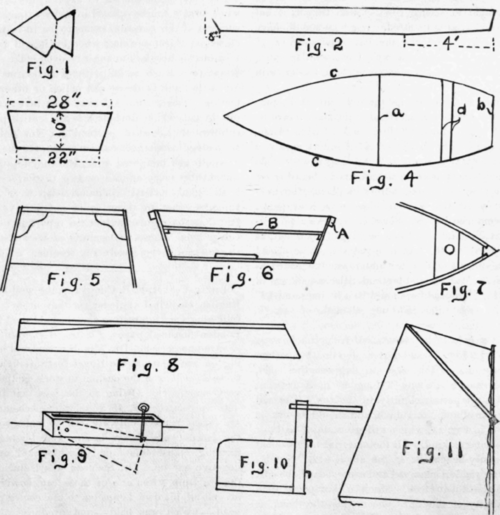
In the stern, about 4" from the top edge, nail a cleat on each side parallel to the top for the seat. The boards for the seats should be 14" wide. Also put a seat the same distance from the top edge, 5' from the stern, and another halfway between this and the bow. Fill in the bow of the boat for 2' from the stem, as shown in Fig. 7. Then fit the two gunwales, 21/2" wide, the entire length of the boat and across the stern, as shown in A, Fig. 6, care being taken in fitting the strips so as to give a finished appearance to the whole boat. If it is not convenient to secure rowlocks, holes may be bored in the gunwales about 3" apart and 9" astern of each seat. The holes should be 7/8" in diameter, and fitted with oak pins 6" long, so that when the pins are in they will project about 4" above the gunwales. It will be preferable to secure rowlocks, as they cost but little and are easily fitted. The boat should have an oak keel, to make the boat row steadier, 7/8" thick and 2" deep, reaching from stem to stern, with a triangular piece at the stern, as shown in Fig. 8.
This boat can be made into a sailboat by putting in a centerboard. To do this, make a center-board box 4' long, 10" high and 1" wide inside, as shown in Fig. 9. Then cut a hole lengthwise in the bottom of the boat 3' 8" long and \" wide through the bottom keel and inside board, after which screw the box securely in place, after having covered the bottom edges with lead paint. The centerboard box should easily take a §" cen-terboard. The board can be hinged by a bolt, as shown in Fig. 10. An iron rod should be placed at the other end to raise and lower the board as needed. Make a rudder and tiller as shown in Fig. 11. The rudder should be 17" long and 12" wide, with a tiller 15" long, all made of oak 3/4" thick.
Cut a hole 4" in diameter 1' from the bow, as shown in Fig. 7, and put a step in the bottom directly under this hole to support the mast, which should be about 10' long, 4" in diameter at the base, tapering slightly to the top. The sail can be made of No. 1 duck, and should be cut as shown in Fig. 12, which will give ample sail for a boat of this kind. All the material for this boat can easily be purchased for about $12. Not including rudder, mast, sail and centerboard, the cost would be about $6.00. Much will depend upon the ability of the one who builds the boat as to what the boat looks like when it is done, but if care is used and the foregoing directions closely followed, you will have a good boat and a fast sailer in smooth water. If not experienced in sailing, however, the sail had best be omitted.
Continue to:


My Books

