


Phonographs. Part 3
Description
This section is from the book "American Library Edition Of Workshop Receipts", by Ernest Spon. Also available from Amazon: American Library Edition Of Workshop Receipts.
Phonographs. Part 3
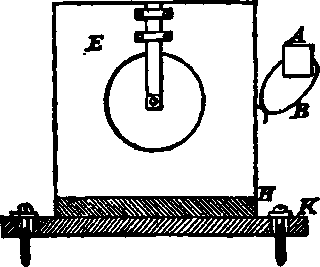
Before putting a tinfoil upon the cylinder, the 2 nuts are removed, and the diaphragms turned back out of the way. A little gum brushed along' one end of the tinfoil will be sufficient to keep it firmly in its place; the join must be carefully smoothed. The diaphragms are then turned back to their places, and the nuts screwed on. The nut on G is screwed up just far enough to cause the point on the iron diaphragm to touch the tinfoil very lightly. The handle is then turned about 1/4 rev., causing the point to make a short scratch on the tinfoil. The nut on G is thereupon loosened, withdrawing the point from the tinfoil, and the nut on H being screwed up, another turn is given to the handle. If the scratch thus produced exactly coincides with the former one, well and good; if not, the screws attaching K to the base must be loosened, and K shifted about until absolute coincidence is attained. The utmost accuracy on this point is essential. The instrument may now be considered fit for use. Loosen the nut on H, so that the point on the spring may be well away from the tinfoil, and screw up the nut on G, so far that the point on the iron diaphragm may score a well - defined furrow on the tinfoil when the handle is turned.
Turn the handle with as great regularity as possible, at the rate of about 1 turn per second, or a little slower. Speak loudly and distinctly into the mouthpiece, putting the mouth as near as possible to it, without actually touching. When you have finished, withdraw the point by loosening the nut, turn the handle backwards until the cylinder is in its original position, and screw up the second nut until the second point presses lightly but steadily upon the bottom of the furrow. Then put on the paper resonator, and turn the handle at the same speed as before. If the adjustments are perfect, the result will be astonishing. It will be observed that this instrument has 2 diaphragms, whereas Edison's latest has only 1, which does both the receiving and the speaking. Bid - well made many experiments with the object of dispensing with 1 of the diaphragms, but never, under any circumstances, obtained so good results with 1 as with 2. Preece told the Physical Society that the employment of only 1 was a "retrograde step." Bidwell does not believe that iron and parchment - paper are the best possible materials for the diaphragms, though they are better than any others tried. The great fault in the iron appears to lie in its tendency to resound forcibly to certain overtones in certain vowel sounds.
Bidwell tried to overcome this by coating the diaphragm with india - rubber, but with no great success. He thinks, however, that a ring of india - rubber between the diaphragm and the flange has an undoubted effect in diminishing the nuisance. The steel spring is subject to independent vibrations of a similar nature. These may be damped by causing a piece of soft indiarubber to press lightly upon it at a point about 1/2 in. below the lower strip of brass. He also found it an advantage to wrap indiarubber round the top of the spring before screwing it on. He believes that the mouthpiece of a telephone would give better results than that of a speaking tube. A long resonating mouthpiece like that which Edison first used is worse than useless. The point on the steel spring should be made to turn very slightly upwards instead of being perpendicular. In the latter case, it is liable to produce a squeak something like that of a slate - pencil when drawn upright across a slate. If the points are too sharp, they will cut and scrape the tinfoil; if too blunt, the articulation will be muffled. After the points have traversed the cylinder 200 or 300 times, they will require sharpening.
This can be done with a small oil - stone, without removing them. (Eng. Mech.)
Fig. 98.
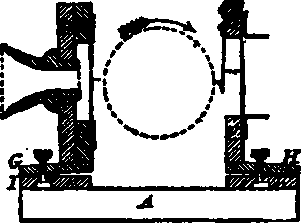
Fig. 99.
The very simple apparatus illustrated in Fig. 100 is a speaking phonograph that can be made and sold for 6d., or even less, and yet leave a profit to the manufacturer. It is the invention of Lambrigot, an inspector of telegraphs at Albi, in the Department of Tarn, in the south of France. The whole apparatus consists, first, of a hollow cone of pasteboard about l 1/2 in. in diameter, whose apex is connected to the centre of a similar - sized pasteboard dise by means of a leaden wire about 16 in. long; and second, of a small board or tablet, on which is fixed 1, or a larger number of short lengths of leaden wire, each of which bears upon its upper surface a phonographic embossed record corresponding to a certain word or sentence, by which it was originally produced by a process to be described further on.
Fig. 100.
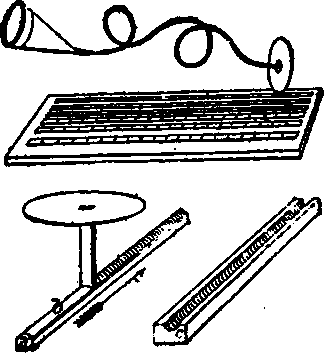
To those who are familiar with the construction of the phonograph in the form in which it was first shown in this count 17, it would appear necessary, in order to reproduce the sounds recorded on the tablet, for the edge of the disc to be held in an annular frame so as to convert it into a diaphragm, and for its centre to be thrown into vibration by means of a point or style projecting from it and drawn over the undulatory surface of the record. But the method of using the apparatus is far 3 simpler than that; all that is necessary is to hold the paper cone against the ear with one hand, and with the other to take hold of the cardboard disc, drawing its edge along the record with a steady scraping motion, and the mechanical vibrations thus set up in the disc being communicated by the wire to the conical earpiece which serves as a resonator and concentrator, produce in the organs of hearing the sensation of the articulate sound by which the markings on the leaden record were originally produced.
We should have thought that a stout thread or a lighter wire would have formed a more efficient as well as a cheaper connection for the purpose than the leaden wire, but we are informed that Lambrigot has found the lead to answer the purpose better than anything else; it does not require to be kept stretched between the cone and the disc, and being of a very inelastic nature, it does not spring about and produce disturbing sounds by clashing against itself or against neighbouring objects. Again, it would naturally be expected that the earpiece would be more perfectly adapted to its purpose if it were in the form of that used in the ordinary thread telephone; that is to say, if it consisted of a cylindrical cardboard box closed at one end with a stretched paper diaphragm, to the centre of which the connecting wire was attached; but simple as it is, this would undoubtedly be a more complex form of construction than the cardboard cones, and would be far more liable to be destroyed by the weight of the connecting wire.
The employment of cardboard as the material of which the principal parts of the apparatus are constructed, is, in the case of the cone, for cheapness, and in that of the disc, partly for cheapness, but chiefly to protect the markings on the leaden record from being destroyed, as they soon would be if a harder material than card were employed.
The most interesting point connected with this very simple apparatus is the method by which the leaden records are produced, which is as follows: - The upper surface of a rectangular prism of glass, or other hard and rigid materia], is thickly coated with stearine wax, which is then scraped into a convex form, as shown in the diagram, in which a represents the glass bar and b the convex coating of stearine. This bar is then fixed into a simple phonographic instrument, which, by means of a screw or other mechanical contrivance, traverses it at a suitable speed below a diaphragm. This diaphragm is rigidly held around its circumference by an annular framework (not shown in the diagram), and is in every respect exactly similar to the diaphragm of an ordinary phonograph. To the centre of this diaphragm is attached a thin flat plate, whose lower end is cut out to a concave curve, to fit the convex surface of the stearine b. When all is properly adjusted, and the temperature is so arranged as to give to the stearine surface the proper degree of hardness to ensure the best results, the handle of the instrument is turned, and at the same time words are spoken against the diaphragm, which immediately set up in it vibrations, which are communicated to the plate or style.
While this is moving up and down, following the vibrations of the diaphragm caused by the voice, the stearine coating of the bar ab is steadily drawn in the direction of the arrow below the vibrating bar, receiving from it a phonogram similar to that produced on the tinfoil of an ordinary phonograph.
The stearine bar is then coated with a fine surface of graphite, so as to give to it an electrically conducting surface, and it is then electro - plated with copper by the ordinary process. Out of the copper coating so formed the stearine is removed, and a rigid backing of lead or other metal having been run over the outside convex surface of the copper, a firm copper - lined matrix or mould is formed, the whole presenting the appearance shown, and consisting of a rectangular block having along the middle of one of its faces a semi - cylindrical groove c of copper, which bears upon its surface certain raised striations corresponding to the depressions which were made by the diaphragm on the surface of the stearine. Into this groove is laid a piece of lead wire about 3 or 4 millimetres in diameter, and the two being put into a press and squeezed together, the surface of the lead wire receives a permanent impression which is an exact reproduction of the original impression made upon the stearine bar.
From one copper matrix a very large number of lead impressions may be made, and we are told that the whole process can be gone through, and lead wires, each containing the record of a short sentence, can be made and sold with a profit for 1/2d. each.
It is an interesting fact that if a small stick of wood, such as the stem of a common match, be substituted for the disc, and its end be drawn along the copper groove of one of the matrix moulds, articulate speech is communicated equally well to the earpiece, although the motion of the point is the reverse of that of the disc; and this bears a very close analogy to the fact that in the ordinary Bell telephone a message is transmitted with equal distinctness, whether the poles of the receiving instrument be reversed or not. (Eng, Mech.)
Continue to:


My Books

