


Mounting Photographs
Description
This section is from the book "American Library Edition Of Workshop Receipts", by Ernest Spon. Also available from Amazon: American Library Edition Of Workshop Receipts.
Mounting Photographs
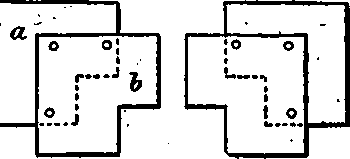
(a) An appliance calculated to be useful, especially to amateurs, when mounting photographs upon cards to show a definite margin, has been brought forward by Starnes. Two pieces of card a b (Fig. 77) are fixed by three tacks upon a drawing board, in the position shown. The corner of the mount is pushed under the card b until it butts against the edges-shown by dotted lines - of the card a The print is then laid down with its corner fitting the angle cut in 6, and thus any number can be mounted upon the cards without the necessity for measuring and marking each mount. It has been suggested that if two corner-fittings (as shown) were used instead of one, the direction of the print upon the mount would be truer; and that if the photographs themselves were not cut exactly of one length, it would be seen, and could be allowed for, keeping the same amount of margin at each end. The top or bottom of the mount should be placed in this double fitting, rather than one of the sides, as a little difference in the height of a print upon the card is permissible, but it must be central as regards the sides.
Fig. 77.
(o) Most photographers are now fully aware that a photograph when wet is larger than when it is dry. This is owing to a property which paper, like many other materials, has of expanding when subjected to moisture. It is also tolerably well known that the expansion is not equal in all directions, as paper, like wood, expands more in one direction than it does in another. A deal board, when wetted, expands considerably in its width, though its length is but little affected. So it is with paper when made in continuous lengths, as all photographic papers are.
This property frequently gives rise to considerable trouble in mounting photographs - particularly when two or more prints have to be joined, as is occasionally the case with large pictures when they have been printed from two or more negatives. Serious inconvenience may also arise through this unequal expansion of the paper in small portraits, by causing a distortion of the features. Two prints made from the same portrait negative, on paper which had been cut in different directions from the sheet, possessed a palpable difference in the length and breadth of the features when they were mounted wet.
Machine-made papers are made in continuous lengths, and are cut up into sheets afterwards. It has been found with nearly all samples that, when strips were cut lengthwise from the roll, the expansion, when they were soaked in water, was exceedingly small, but when cut transversely the expansion was very great; and what is- of material importance in mounting photographs, it was found that strips so cut could be stretched considerably more. For example - a strip of Saxe paper 24 in. long, cut transversely from the roll, by being mounted wet and gently stretched while mounting, could be made to measure fully 25 in., and with care it could be made considerably longer. If the paper be allowed to dry after being wetted and expanded, it will contract again, but not quite to its original dimensions, though it does very nearly. Hence, if prints are required of the size of the original negative, they should be dried before, mounting, and then wetted as little as possible in the operation. A solution of gelatine containing a large proportion of alcohol is recommended for the purpose.
With a view to avoid the distortion sometimes existing in carte or cabinet-sized prints, when they are mounted wet and are liable to be stretched somewhat by the mounter, the same system and mountant should be employed.
(c) By Cowan's system, the distortion caused by the expansion of the paper, which at times becomes a serious inconvenience, is practically avoided. The method also possesses many other advantages - simplicity and cleanliness not being the least. Although the principle of cementing the print and allowing it to become dry before mounting is not new, yet the method differs somewhat from those hitherto published.
The prints, after they are taken from the washing water, are laid face downward on a plate of glass - not in a neat pile, as usual when mounting is done wet, but just as they are collected in the tank. The glass, with the adhering prints, is then reared on end to allow the superfluous water to drain away.
When the prints have drained for a short time, they are brushed over with starch paste in the ordinary manner. Each print as it is starched is lifted from the glass (by raising one corner with the point of a knife), and laid out to dry. The drying arrangement is deserving of notice, as being exceedingly convenient when large numbers have to be dealt with, or space is somewhat circumscribed.
Cowan has a number of wooden frames covered with canvas. In each corner is a screw projecting about 2 in. When one of the frames is covered with the starched prints, another' frame is placed upon it - the projecting screws preserving a space of 2 in. between the two. When the second frame is filled, a third is put into position, and so on with any number of frames that may be required. The prints dry quickly on these frames, are preserved from dust while drying, and the whole arrangement occupies but little space. The starched prints also dry without curling up, which is a great convenience in the after manipulations. After the prints become dry they are trimmed, and are then ready for mounting at once, or they may be kept for any length of time (several years) without deterioration.
The method of mounting is exceedingly simple. A pile of cards is placed on the table, and the top one is then slightly damped with a clean sponge moistened with water. This card is now drawn slightly forward on the pack, and the print is then adjusted in position upon it. This is easily done as the dry starched surface has no tendency to stick to the card, as it would have if it were wet. When the print is placed in position, it is held there by a couple of fingers of the left hand, while the thumb and two fingers (slightly separated) of the right hand firmly grasp the bottom of the card together with the print. In order to prevent the print being misplaced, the thumb is pressed firmly enough to bend the card between the fingers considerably. All that now remains is to pass the print and card between the rollers of an ordinary rolling press, when the print will .be found to adhere with great tenacity. Indeed, so firmly adherent is the print after haying passed through the press, that it is impossible to separate it from the card without tearing. Hence, the necessity for holding the print and card firmly until they are gripped by the Tollers will be apparent.
Continue to:


My Books

