


385. Assembling The Parts Of A Boiler
Description
This section is from the book "An Elementary Outline Of Mechanical Processes", by G. W. Danforth. Also available from Amazon: An elementary outline of mechanical processes.
385. Assembling The Parts Of A Boiler
After the plates composing a boiler have been trimmed to finished dimensions, rolled to the required curvatures, flanged, and have had enough rivet and other holes drilled for bolting them together temporarily, the next step is to assemble them into correct relative position. The plates of the shell are first assembled in rings or courses, and the several courses are then assembled end to end; the combustion chambers and corrugated furnaces, which are placed inside a cylindrical boiler, are assembled complete in themselves, and when they are placed inside the shell, the boiler heads are placed in the ends of the shell.
As each group of plates is assembled, rivet holes are drilled in the lapped edges at the seams, the plates are taken apart, cleaned, re-assembled and finally riveted permanently together.
The combustion chambers are held rigidly in place in the boiler by suitable stay bolts which fasten them to the shell, or fasten adjacent chambers to each other. (See Fig. 221.) The tubes join the combustion chamber to the boiler head and serve to increase the rigidity of the combustion chamber while fulfilling their purpose of conducting gases of combustion from the furnace to the smoke pipe. Tubes are placed after all other parts are assembled and riveted, and after the screw stays are placed.
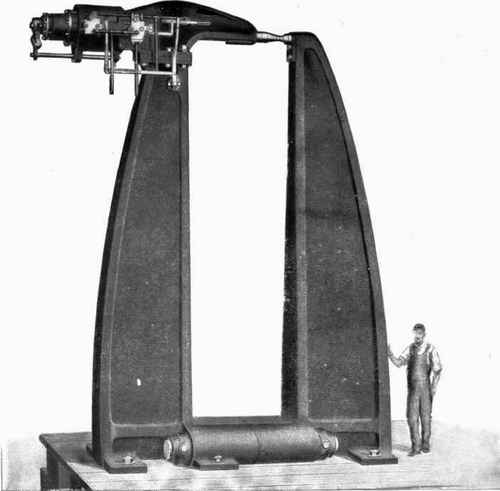
Fig. 234. - Hydraulic Riveting Machine.
Continue to:


My Books

