


Historical Outline Of Steam Navigation. Part 4
Description
This section is from the book "The Engineer's And Mechanic's Encyclopaedia", by Luke Hebert. Also available from Amazon: Engineer's And Mechanic's Encyclopaedia.
Historical Outline Of Steam Navigation. Part 4
The steam cylinder was 2 feet diameter, with a 4 feet stroke; the paddle wheels were 15 feet in diameter, the floats were 4 feet wide, and dipped in the water 2 feet.
Early in the autumn the vessel started on her first trip, which was to Albany, distant about 150 miles; which distance she accomplished in 32 hours. The voyage back was performed in about the same time, and both in going and returning, the wind (a light breeze) being ahead, the whole was performed by the engine.
This triumphant experiment established Fulton's reputation; and soon after, this fine vessel plied between New York and Albany as a passage boat. Her success was such, that a new vessel of larger dimensions, and of greater proportionate power, was commenced during the same year. From that date steam navigation was firmly established in America, and went on extending with astonishing rapidity. Fulton in consequence realized large sums, but his prosperity was not without alloy, and he was doomed to experience the lot of most mechanical inventors, who are too frequently exposed to mortification, as well by the success as by the failure of their schemes. No sooner had he established the practicability of his plans, than attempts were commenced to infringe upon or evade his patent; and he was from that time continually engaged in a series of lawsuits, to protect his hard-earned privileges. In consequence of the expense attending these proceedings, and that of the experiments he was constantly engaged in, although he lived without ostentation or extravagance, his affairs after his death (which happened in February, 1815) were found to be excessively involved; and it is to be feared that his family reaped but little benefit from his meritorious labours, which have been productive of such signal benefit, not only to his own country, but to the world at large.
Although we have said that in one sense Fulton may be considered the inventor of steam navigation, we feel that this is not exactly the position which he occupies in relation to this invention, and we use the term for want of one as compendious, and at the same time more accurate. Strictly speaking, Fulton cannot be said to have contributed anything to the invention. As regards the mere idea of moving vessels by steam, Dr. Allen and Hulls had each invented and published practicable plans, by which it might be effected, more than 70 years prior; neither was he the first to attempt to realize those schemes, either here or in his own country; and if it be said that he was the first who attained complete success, we reply that both Symington and Rumsay had fully triumphed over the mechanical difficulties of the task, and the invention was completed before he took it in hand. And yet, notwithstanding that this is (we think) undeniably trne, it is in our opinion equally true that to him we owe the gift of steam navigation, with the various blessings which it has bestowed.
Although the invention had been completed by others, it might be considered as lost to society, which did not appreciate its value, until Fulton by his untiring energy and perseverance, practically demonstrated its transcendant importance, and forced conviction upon his ignorant and incredulous contemporaries. In corroboration of this view of the subject, we would add, that notwithstanding Symington's successful labours, it was not until nearly ten years after their termination that the first steam boat was established in Great Britain, and then principally in consequence of the notices which from time to time appeared of the progress of steam navigation in America.
On the next page are given engravings of the arrangements of a Scotch steam boat, which is common on the river Clyde. Fig. 1 represents a longitudinal and vertical section, from stem to stern; and Fig. 2 a plan of the same, showing the deck removed. Similar letters in each figure refer to corresponding parts. At a a are the boilers; 6 the chimney, leading from the flues of both the fires; c is the steam pipe, which receives the steam from both the boilers, and conveys it by a cross tube to the two cylinders d d, through the valve boxes atff. The air pumps e e are worked by the main-beam, and the eccentric, for giving motion to the valves, is shown at g. h h paddle wheels; i one of the paddle boxes in section. At j is the fore cabin, k the after cabin, o o the staircases, lll the framing of timber, which supports a platform or deck, (commonly called the gangway,) which nearly surrounds the hull of the vessel.
No attempts were made, we believe, to perform sea voyages by steam boats, until the year 1818; when they were established by Mr. David Napier. Shortly afterwards, the Irish mails were conveyed between Dublin and Holyhead by regular steam packets.
At length the longest voyages were attempted by steam. In the year 1825, the Enterprise, a vessel of 470 tons burthen, and 120 horses, power, sailed for India. She left the land on the 16th of August, and reached Calcutta, Dec. 7, 1825; being 113 days from the land to Diamond Harbour. She used boh sails and steam. The greatest run by sail in 24 hours was 211 miles; the least 39 miles. The greatest run by steam, assisted by sail, was 225 miles; the least 80 miles. She steamed 64 days, and the rest of the time was under sail. The consumption of coal was 5S0 chaldrons, or about 9 chaldrons per day. She rendered essential services to our arms during the Burmese war.
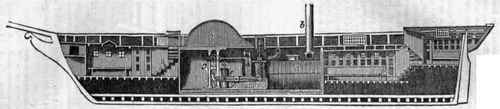
Fig. 1.
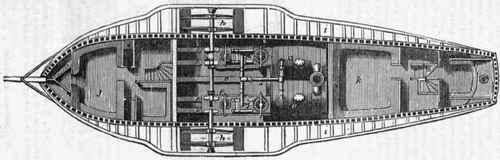
Fig. 2.
A recent application of the power of steam, which is calculated to be of signal benefit to the commercial marine of this country, is the employment of it on a limited scale as an auxiliary to shipping during calms and light airs One o the first vessels in which steam was so applied was the Maria, of 460 ton register, which sailed to Bombay. She was fitted with a propelling apparatus, the invention of Mr. J. Melville, and designed principally for the purpose of propelling sailing vessels in calms, to which purpose, it appears to us to be extremely well adapted. The annexed figure shows an elevation of the apparatus as applied to the Maria. a is the engine shaft, situated between the two propelling shafts, b and c. These three shafts are caused to revolve together with equal velocities, by means of three spur wheels, of equal diameter, fixed one upon each shaft within the vessel; and therefore shown by dotted lines. Upon the outer ends of the shafts b and c are fixed the cranks d and e, in diametrically opposite directions, so that they remain constantly parallel to each other; but whilst one crank is ascending, the other is descending; f and g are the propelling levers, or stems, to the lower ends of which the floats m and n are attached.
Continue to:


My Books

