


Preface To The New Edition
Description
This section is from the book "The Engineer's And Mechanic's Encyclopaedia", by Luke Hebert. Also available from Amazon: Engineer's And Mechanic's Encyclopaedia.
Preface To The New Edition
The rapid progress of Mechanical Science has developed many most important facts since the first publication of this Encyclopaedia. The inventions and discoveries recently made have engaged the sedulous attention of the Editor: for, as the value of each was tested by experiment, a description was accordingly prepared. By the selection of new articles, and care in the abridgement and revision of old ones, this Edition has become systematically enriched: so that it may be received, as fully and faithfully expressing "the existing state of Engineering and Mechanism," adapted to the wants of Practical Men.
The unexampled sale of the early edition, and numerous successive reprints, urgently demand another suited to the present state of science. The Author has therefore cheerfully obeyed the commands of his patrons in placing before them in this new Edition the result of his late active and pleasing occupation, in a form re-modelled, enlarged, and, as he believes, considerably improved.
The article "Railway" has been entirely re-written, and divided into numerous explanatory Sections. These Sections, although separate and independent, collectively form one continuous and perfect Treatise on this important national subject, capable of easy and immediate reference on the most minute points.
Many alterations have been suggested, improvements introduced, and inventions patented, connected with Locomotive Engines and Railway Carriages, calculated, it is hoped, if carried into practice, to prevent the recurrence of future calamitous accidents. On this momentous subject the
To accomplish an undertaking of such great convenience to the scientific, as well as of real utility to operative men, in a form adapted to instant reference and ready application, has been my chief aim in the present work, which will comprehend, in addition to the usual matter contained in cyclopaedias on the mechanical and chemical sciences, upwards of two thousand modern inventions and discoveries of merit and originality, illustrated by Engravings carefully executed from accurate working drawings.
Notwithstanding the extent and variety of subjects which this work embraces, it may be necessary to remark, that by the adoption of a small type, and close printing, the economy of space is so far attained as to admit of each subject receiving the consideration due to its importance, and to comprise the whole in two thick octavo volumes. Thus, the preparation and numerous manufactures of that invaluable metal, the indispensable material of our machinery, (Iron,) has received particular attention: so have, likewise, the various manipulations and mechanism employed in our great staple commodities, cotton, silk, woollen, and linen. The construction of engines (particularly steam engines), MILLS, RAILWAYS, CARRIAGES, SHIPS, BOATS, DOCKS, CANALS, BRIDGES, FURNACES, BOILERS, GAS MACHINERY, LOOMS, PRESSES, PUMPS, PADDLES, PLOUGHS, STILLS, WATCHES, CLOCKS, WATER-WORKS, WHEELS, CRANES, STOVES, and a thousand other subjects, receive, in like manner, their share of attention. The various important processes of dyeing, DISTILLING, BLEACHING, BREWING, TANNING, and numerous other chemical manufactures, present also conspicuous features in the contents of this work, the whole of which may be said to combine an exposition of the entire series of fhe Mechanical and Chemical Arts of the British Empire.
Luke Hebert.
PATERNOSTER Row,
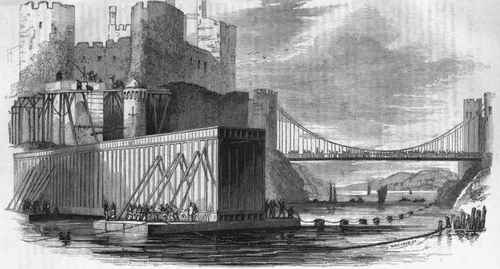
The Iron Tunnel Or Tubular Bridge Over The River Conway, As It Rested On The Pontoons When About To Be Towed To Its Destination.
[See Article Railway, Vol. II.]
Continue to:


My Books

