


Inkstands
Description
This section is from the book "The Engineer's And Mechanic's Encyclopaedia", by Luke Hebert. Also available from Amazon: Engineer's And Mechanic's Encyclopaedia.
Inkstands
Utensils for holding ink for the convenience of dipping a pen into them. They were formerly chiefly made of horn, but now generally of glass or metal. It is not our intention to describe the ordinary kinds, that are familiar to every eye, but only the recent elegant improvements which have been made upon them.
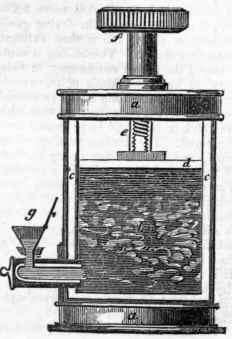
Edwards's Patent Inkstand is one of great convenience and stability, and not very liable to get out of order. It is represented in the subjoined engraving, which affords a sectional view of the interior, a a shows the top and bottom of an external cylindrical casing of bronze, b is the ink imbibed by a quantity of loose hair or wool, contained in a cylindrical glass cup c c, of considerable thickness, the upper part of which is closed by a glass piston d, accurately ground to fit the cylinder, and so as to permit it to move easily up and down. On the upper surface of the glass piston, a hollow screw e with a disc of metal at the end, is made to operate by pressure downwards, when the top piece f is turned by the finger and thumb; the latter turns the solid screw, and causes the hollow screw to advance or recede with a sliding motion, so as to press uniformly upon the piston without the friction of turning against its surface. At the lower part of the reservoir, an aperture is made, into which a tube is fixed that conducts the ink to a little pen-supplying cup g, when the wool is compressed by a turn of the screw, forcing down the piston.
The little cup, previously empty, is thus instantly supplied with fresh ink, with no more trouble than taking up a pen; and should a little more ink be forced into the cup than is necessary, by carelessly turning the screw too far, it runs over, and is caught in the little saucer shown below. When the inkstand is not in requisition, a half turn of the screw the reverse way causes the ink to flow back again, as the wool being thereby relieved of the pressure, re-absorbs the fluid. The ink being thus returned into the reservoir, none can be spilled, even if upset; it is preserved from the contact of the air, consequently from drying up, as well as from dust, and it may be instantly brought into use whenever required. These are decided advantages, which peculiarly recommend it for the use of persons travelling.
Continue to:


My Books

