


Bookbinding. Part 5
Description
This section is from the book "The Engineer's And Mechanic's Encyclopaedia", by Luke Hebert. Also available from Amazon: Engineer's And Mechanic's Encyclopaedia.
Bookbinding. Part 5
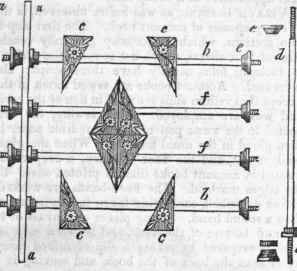
Whole bound books are frequently very handsomely gilt on the sides as well as the back, frequently by running a broad gold roll round the edges of the cover, and sometimes by means of corner and centre pieces, with or without lines. The following ingenious method of working these ornaments was designed by Mr. Bain, of Broad-court, Long-acre, who received the silver Isis medal and five pounds, from the Society of Arts, for his invention. The brass ornaments used for the covers are mostly triangular ones for the corners, the centre being formed by the combination of the same or other four pieces. In the ordinary manner of working, a single tool is used, which requires to be applied eight times on each cover, or sixteen times in all on each book. This occasions the loss of much time; to save the greater part of which, Mr. Bain employs four triangular blocks, capable of being fixed in a simple adjustable frame, so as to suit any sized book. The frame a a in the accompanying engraving, is made to hold the rods b b parallel to each other, and allow them to be set at any required distance apart. cc c c are the stamps, which are perforated to slide on the rods b b quite even with each other; they are fixed at the proper distances on the rods by small set screws at their back, which bind upon the rods.
The frame a a has two long apertures, seen in Fig. 2, to receive the rods b b, which have square shoulders and fins to traverse along, and are bound fast by the screwed nuts, dd shows one of the rods, with its nut separate. The small nuts e screw on after the stamps, to keep them from falling off the rods before they are adjusted. It will be seen that by sliding the stamps c along the rods b, and these rods along the frame a, they may be adjusted to suit any size and form of book. When the corners are done, if the same stamps are to be used for the centre, they may be transposed on the rods, and adjusted to suit the centre, as shown at f f; but it will save time, and do the work truer, to have four rods b b and f f to hold the corners and centre stamps at the same time, for then once putting in the press does one side of the book, and all will be exactly alike, without much care on the part of the workman. If the frame a a is made a little wider than the thickness of the stamp on the pattern side, it might be adjusted to touch the fore-edge of the book, which would keep the pattern quite straight and equidistant on each book. By this contrivance, not only is time saved, but the patterns are registered much more accurately than they could possibly be by any other method.
When very large lettering pieces, ornaments, or coats of arms, etc. are to be gilt upon the covers of books, manual pressure is inadequate to the working of them, and a press is employed, called an arming press. A very perfect machine of this description has recently been constructed by Messrs. Cope and Sherwin, of London, to which they have given the name of the " Imperial Arming and Embossing Press," which is not only capable of working every description of gilding, but is also sufficiently powerful to emboss the elegant arabesque covers, at present so much employed for ornamental bookbinding. The largest description of these covers are embossed by means of a fly-press of enormous power, but for all smaller work the imperial press is amply sufficient. In its construction it resembles the improved printing press invented by the same parties, but with the addition of a contrivance for raising or lowering the bed to suit the thickness of the book, and the flatten likewise having receptacles for the heating irons.
By means of a screw-and-wedge adjustment in the piston, and the rising and falling bed-plate, a considerable range, with the power of very accurate adjustment, is obtained with great facility This machine is exceedingly simple in principle and construction, elegant in appearance, and effective in operation, and is a valuable auxiliary to the book-binder. The book having been gilded, it is polished with a hot iron,- and the edges, if coloured or marbled, are burnished with an agate burnisher: the book is then finished. If the book was only intended to be put in boards, or, as it is technically called, boarded, it is folded, sewed, glued, the covers cut to the size and put on, and then covered with coloured paper, the edges of the book remaining uncut. Extra boarding has stouter boards than the former, and is finished with rather more care; sometimes the edges are cut, and the book covered with a neat coloured and embossed or printed cloth, which gives a very neat appearance at a cheap rate.
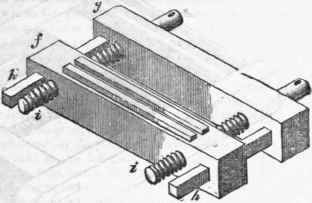
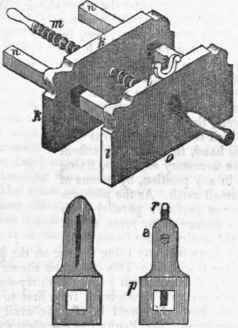
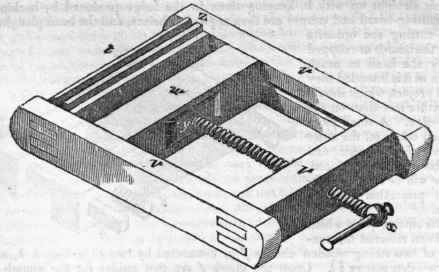
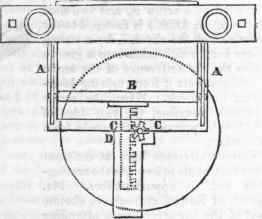
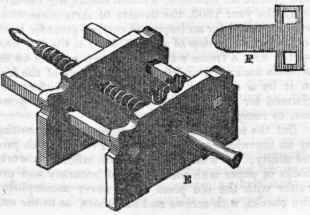
Fig.2.

Fig l.
Vellum Binding, as was before observed, is the term applied to the binding of every species of account book. The first step is to fold and count the paper into sections, which in foolscap generally consists of six sheets; above that size, of four sheets, which are sewed upon strips of vellum. Small books, up to foolscap folio, usually have three strips; above that size the number is increased. Account books are sewed much in the same way as printed books, except that vellum slips are used in lieu of the cords, and a much stronger thread and wax are employed. After sewing, the first ruled leaf at each end is pasted to the waste paper, and the marble paper lining introduced; the back is then glued in the usual manner. When the glue is dry, the fore-edge of the book is cut, and the back rounded, a deeper hollow and rounder back being formed in account books than in printed ones. The two ends are then cut, and the edges marbled. The head-bands are worked on a slip of stout board, as before described, care being taken in this instance to form a deep narrow, rather than a round band.
Continue to:


My Books

