


Air Balloon. Continued
Description
This section is from the book "The Engineer's And Mechanic's Encyclopaedia", by Luke Hebert. Also available from Amazon: Engineer's And Mechanic's Encyclopaedia.
Air Balloon. Continued
Mr. Blanchard applied a species of wings to the car, but was unsuccessful in hi3 attempt to travel against the direction of the wind; nor was Morveau more fortunate with large oars or sails, introduced with the same design. Numerous contrivances have been since adopted, but all have been ineffectual in practice; and, indeed, when the great extent of surface which a balloon presents to the impulsive force of air in motion is duly considered, the probability of overcoming that force by any means which can be commanded by the aerial voyager, seems very remote.
Endeavours have also been made to economize the gas which the balloon contains. A much larger quantity than is necessary to create the buoyant power required to carry up the voyagers, is introduced, and to occasion the descent of the machine, the gas is permitted to escape by a valve; but if the aeronaut require again to ascend in consequence of the unfavourable nature of the ground on which he is likely to descend, or from any other cause, he must part with ballast, which may be essential to his safety. The Duke de Chartres, accompanied by Charles and Roberts, ascended in a balloon filled with hydrogen gas, which contained a smaller within it, to be filled with common air, by means of a pair of bellows, as occasion might require. By inserting common air into the small balloon, the specific gravity of the machine would be increased, and it would descend without loss of gas, and reascend by withdrawing the common air. However ingenious the contrivance, it was not found successful in practice, chiefly, perhaps, on account of the unfavourable state of the wind, which was tempestuous when the experiment was made. Pilatre de Rozier and Mr. Romaine, with the same design introduced a balloon filled with healed air below the ordinary balloon containing hydrogen gas.
The buoyant power of the heated-air balloon was equal to about 60 lbs.; and by removing the source of heat, the specific gravity of the whole machine was increased, so that it was not necessary to part with any gas during a voyage. The attempt to carry this plan into execution was fatal to both voyagers. The upper balloon, by means unknown, took fire, and the intrepid De Rozier and his companion were precipitated to the earth and killed. It is not our purpose to describe the various attempts that have been subsequently made to improve the construction of balloons, or to render them subservient to scientific purposes, since little has been effected towards accomplishing these objects. We cannot, however, omit a description of an addition to the balloon, called a parachute, which was first employed, with daring courage, by M. Garnerin.
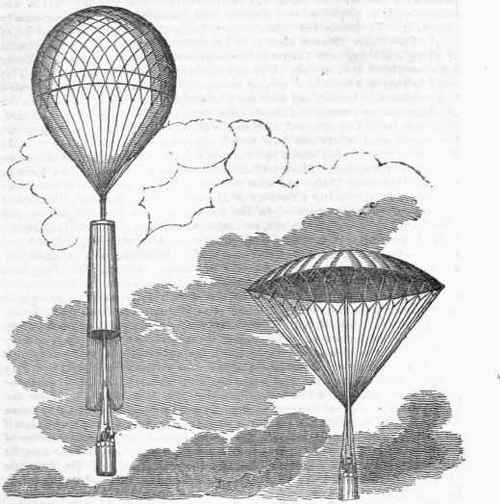
The balloon was of the usual form, made of oiled silk, and filled with inflammable gas: it was covered, as represented in the annexed engraving, with a netting, from which cords proceeded that were tied together at a few feet below the balloon; the several cords thus collected were then twisted so as to form a single rope, which was passed through the parachute, and fastened to the car, or basket. The real structure of the parachute is best seen in its expanded state, as shown in the descent, forming a near resemblance to a large umbrella; it was made of canvass, and about thirty feet in diameter; it had no ribs, the figure of its dome being preserved by the surrounding cords. The length of these cords, or ropes, from the edges of the dome of the parachute, to where they are connected together, was about 30 feet; and from this point of connexion, other shorter ropes proceeded, which were attached to the edges of the circular basket in which the aeronaut was situated. In the place of the handle of a common umbrella, a long tin tube was fixed in the parachute, through which the single rope before-mentioned was passed, to prevent its becoming entangled, and to allow it to slip away with certainty when severed for the purpose of descending.
The ascent took place on the 21 st of September, 1802, from St. George's Parade, North Audley-street.
The balloon began to be filled about two o'clock; 33 casks filled with diluted sulphuric acid, together with a quantity of iron filings, were employed for the production of the hydrogen gas. These communicated with three other casks, or general receivers, to each of which was affixed a tube that emptied itself into the main tube connected to the balloon. At six o'clock the balloon was completely filled; when it rose with its long appendage of the parachute, the aeronaut in the little basket closing the train. Thousands of acclamations rent the air, while the eyes of tens of thousands of spectators were fixed in astonishment and admiration at the gallant adventurer; feelings which could be only surpassed by the most intense and painful anxiety for his safety. The weather was beautifully fine, with scarcely any wind. For eight minutes this intrepid man continued to ascend, till he arrived at such an immense height as to be scarcely visible, when he cut away the balloon. The parachute did not expand immediately, and he fell with great velocity for a short space of time; when it opened, and his descent became gradual, but attended with a remarkable oscillation, like the pendulum of a clock, to that degree, at one time, that the parachute, cords, basket, and aeronaut, appeared to be stretched in an horizontal line.
At length, as he approached the earth, these vibrations were less extended, and continued to diminish till he reached the ground, which he did without any injury to himself, or the apparatus, which he brought down with him, in a field near the Small Pox Hospital, at Pancras.
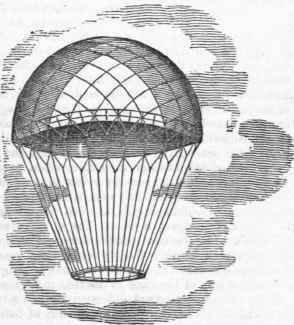
The balloon was observed to ascend rapidly after separation from the parachute, and was soon out of sight It has been suggested to combine the parachute with the balloon so as to add nothing to the bulk, and but little to the weight of the machine; it is as follows: - The band which divides the upper hemisphere of the balloon from the lower one, is to be formed of a wooden hoop, to which the net-work which covers the upper hemisphere, is to be firmly attached; the cords which descend from this hoop, are to be fastened together in the usual manner, below the balloon, but not attached to the lower hemisphere; now, if the upper hemisphere of the balloon should burst, the gas would escape, the balloon would begin to fall, and the lower hemisphere would immediately fall into the direction here represented, lining the upper one, and forming a complete parachute. Should the lower part burst, the escape of the gas would not be so sudden as in the former instance; but when it had escaped, and the balloon began to fall, it would immediately form itself into the same shape as before: in this latter case, it would, perhaps, be better to open the valve at the top, by which means the balloon would sooner be formed into the shape of a parachute.
This plan has, perhaps, these advantages over the common parachute; viz. 1st. That of taking up less room: 2d. Being less weighty: and 3d. Not being subject to that great and sudden fall which must render the use of the common parachute not only unpleasant, but extremely dangerous.
Mr. Green, who has made more than two hundred successful ascents, first employed the ordinary coal gas, in lieu of hydrogen, or heated air, to gain the buoyant power. As the specific gravity of this is considerably greater than that of hydrogen, it is necessary to employ a large balloon when coal gas is used. Mr. Green's present balloon contains about 24,000 cubic feet. There is much economy in using this substitute, as the cost price of sufficient coal gas does not exceed twenty pounds; but the expense of generating as much hydrogen gas as the balloon requires, amounts to nearly a hundred pounds. The latter product of the distillation of coal, when the more valuable illuminating gas is evolved, answers the purpose best, as it contains much less carbon, and is consequently, considerably lighter. The best material for constructing a balloon, is the silk stuff called lustring. When cut into gores it should be stretched by weights, or other means, and kept in this state several hours before it is varnished or sewn.
It is usual to apply boiled linseed oil, containing a small quantity of oxide of lead, for the first coat of varnish, and a solution of caoutchouc (Indian rubber) in oil of turpentine, for the last.
The seams should be doubly sewn and overlapped; and, when finished, a hot smoothing-iron should be passed over them, the silk being protected by an intervening sheet of paper. The gores should be cut with great precision. A net-work of strong hempen twine should be accurately fitted to the balloon, the meshes at the upper extremity being smaller than those below. To the separate cords which terminate the net-work, a circular hoop is attached, from which the car is suspended by strong ropes. The whole of the net-work and ropes should be so adjusted, that the strain, or pressure, is equalized over the whole surface of the balloon. The valve for permitting the escape of gas must be retained in its place by a sufficient spring; and to render it perfectly air-tight, a luting of wax and oil is generally employed around the edges. The cord by which the valve is opened passes through the interior of the balloon; and great care is necessary to prevent it being entangled. The extremity of this cord should never be fastened to the car, as in the event of its oscillation, the valve might be opened, and retained in that state until the greater part of the gas escaped.
A grappling-iron, attached to a strong rope, is an indispensable appendage to a balloon.
As much ballast as can be taken should always be employed.
It frequently occurs that the aerial voyager is far above the clouds, and loses sight entirely of the earth by their intervention; on passing through them, he may find that the spot on which he is descending is unfavourable. A few pounds of ballast thrown out, will occasion the balloon again to ascend, and pass over the inappropriate landing-place. The writer of this article was thus situated; and all the ballast being discharged, he was in imminent danger of descending in an arm of the sea. A contrary current, near the surface of the earth, however, gave the balloon another direction, when escape seemed almost impossible. The appearance of the scenery below to an aeronaut is inexpressibly beautiful; but as a bird's-eye view only can be taken, no correct opinion can be formed of the altitude of buildings, hills, or trees. On this account, much of the grandeur of an extensive prospect is lost. The chief inconvenience experienced is from the sudden variations of temperature. The upper regions of the atmosphere are intensely cold when the sky is cloudless, even although the sun be shining in meridian splendour.
In an ascent made in August, when the thermometer was 74° in the sun at the time of ascent, the writer observed, in less than twenty minutes, that the mercury indicated a temperature of 31°.
Continue to:


My Books

