


System Of Steam Heating
Description
This section is from the book "Cassell's Cyclopaedia Of Mechanics", by Paul N. Hasluck. Also available from Amazon: Cassell's Cyclopaedia Of Mechanics.
System Of Steam Heating
The diagram shows radiators in Ave rooms of a three-storey house. This apparatus is on the one-pipe system. The boiler is in the basement. The main steam circulation can be 1\ in., with single radiator branches of 1-in. pipe. The larger rooms (say 16 ft. by 14 ft. by 9 ft.) will require radiators with 22ft. of surface each, and the smaller rooms (say 12ft. by 10 ft. by 8ft.) 12 ft. of surface each. Endeavour to get the rising main from the boiler up to its highest point as quickly as possible, and without any radiators on it. It will be seen that this pipe would havesteamandcondeused water travelling in it in opposite directions, and this is a frequent cause of noise. The thin pipe (1/2-in.) shown at the foot of the rising main is a drip to take the water from this point to the boiler. All radiators are correctly shown as connected on to the falling pipe. The fall of the main from its highest point is lin. in 10 ft. Radiator branches rise from the main to the radiators. There is only one connection to each radiator, and this has a valve to control it. A trap or cistern is not needed, as the condensed water is returned to the boiler. A cold supply service is laid on to the boiler with a stopcock, and, as the water-line falls, water is allowed in to make good the loss.
The loss, however, is very trifling, and sometimes the water may not need replenishing for days. A steam boiler with 15oft. capacity will suffice, one that is a little larger, however, requiring less frequent attention. There should be an automatic draught regulator.
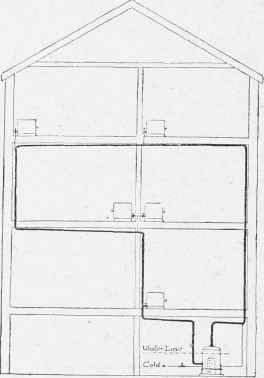
Steam Heating.
Continue to:


My Books

