


Replacing A Broken Or Cracked Window Pane
Description
This section is from the book "Cassell's Cyclopaedia Of Mechanics", by Paul N. Hasluck. Also available from Amazon: Cassell's Cyclopaedia Of Mechanics.
Replacing A Broken Or Cracked Window Pane
Knock out the old glass and putty. This can be done with an old knife worn down to about 2 in. or 3 in. from the handle. When the knife has made its way into the putty, keep it flat against the window frame and hit it with a hammer. Work all round the frame in this manner until all the old putty is removed, care being taken not to chip the window frame by driving in the knife too far. The putty being removed, get a little paint, and apply it all round the rebate of the frame, and after it has dried a little take some fresh putty in the right hand and press a thin layer round the frame with the thumb. Put in the pane of glass, press it evenly all round to bed it in the putty, and fix it on each side with two small tacks driven into the window frame with a light hammer, allowing the heads of the tacks to protrude about; in. Putty the outside of the pane all round and bevel it with a sharp knife, resting against the edge of the window frame and on the glass in the manner illustrated, pressing the thumb against the side A. The figure also shows the cut putty at B, the uncut putty at C, a portion of the framing at D, and the window pane at E. The glaz ing is completed when the surplus putty on the inside has been removed.
When ordering glass to be cut to size, first take the exact measurements of the window frame, and deduct 1/16 in. from each edge, or gin. from two sides: thus: if the window frame is 12in. by 9 in., the glass will be ll 7/8 in. by 8 7/8 in., so that if the glass or frame is not quite square the glass will still fit in, besides allowing the putty to bed against the edges. Putty can be softened with linseed oil, and is best kept in a can and covered over with the oil.
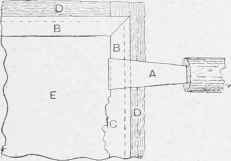
Replacing Broken Window.
Continue to:


My Books

