


Removable Vestibule Screen
Description
This section is from the book "Cassell's Cyclopaedia Of Mechanics", by Paul N. Hasluck. Also available from Amazon: Cassell's Cyclopaedia Of Mechanics.
Removable Vestibule Screen
The sketch shows how a frame may be fixed, without injury to the premises, as a tenant's fixture, removable at the expiration of the lease. No plugs are allowed to be put into walls, and where fixing is required it must be done by means of screws - nails are not permissible. Take the exact width between walls, and allow l 1/4 in. narrower in the outside width of the frame. The skirting projects, say, § in. on each side; the frame must be scribed over this equally on each side, as shown. Get four brass angle-prates C, chamfered on face for preference; let one side into the edge of the frame in each case, the other screw on to the face of the skirting. This will securely fix the lower part; an additional fixing is obtained by screw D into floor. The upper part must be secured by means of folding wedges B, 4 in. wide, between the frame and plaster. These should be driven tightly home, and should be placed as nearly as possible over the jamb at the top and at the level of the transom at the side. When the frame is firm, drive some fine brads through the edge of the frame into the wedges, to keep them from moving if the frame is jarred by the banging of the door at any time.
The fillets A shown on the edge may now be fixed; they must be scribed over the skirting and to the plaster, and fixed to the frame with panel pins. These fillets completely hide all fixing with the exception of the end of the brass bracket on the skirting, and this is not unsightly. The job, if carried out properly, will be a good one, and the screen, while equal in stability and appearance to a permanent fixture, can be quickly and easily removed.
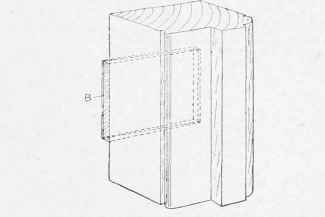
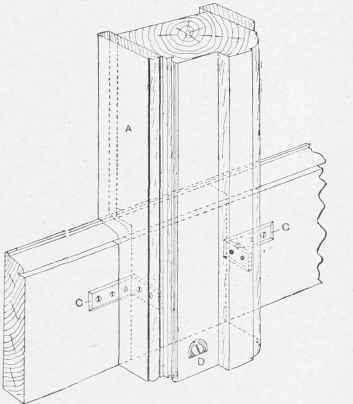
Vestibule Screen as Tenant's Fixture.
Continue to:


My Books

