


Postage Stamp Photographs
Description
This section is from the book "Cassell's Cyclopaedia Of Mechanics", by Paul N. Hasluck. Also available from Amazon: Cassell's Cyclopaedia Of Mechanics.
Postage Stamp Photographs
In a postage stamp camera a battery of small lenses is always employed, both for the sake of speed and for economy, and for these lenses a square bellows is essential. Postage stamp photographs may, however, be produced as follows. Make (to serve as a copy) a negative, postage stamp size, on a 1/4-plate or on a smaller plate, and fix this negative in the centre of a glass in a 12-in. by loin, frame, placing between it and the glass a sheet of white, smooth card in which a hole the exact size of the small negative has been cut. This card serves as a mask for the dry plate on which the negative is to be multiplied. A trial should be made on a small plate in order to ascertain the exposure necessary to give the correct contrast and gradation in the finished negative - for it must be borne in mind that the plate exposed behind the negative will give a positive from which the final negative (that is, the negative from which the prints are to be obtained) must be made in a second exposure. The white card is then ruled into spaces as shown in the diagram, and the negative is placed for the first exposure as indicated by the dotted lines.
Now move the negative forward one square after each exposure till the end of the row is reached, when the operation is repeated along the remaining rows of squares. Of course, the exposures must all be made to the same light and at exactly the same distance from the light. This method of multiplying a negative is far simpler than at first sight appears, for, when properly understood, the whole series of exposures may be made in a surprisingly short time. From the positive so obtained several negatives may be made from which thousands of photographs may be printed in a day.
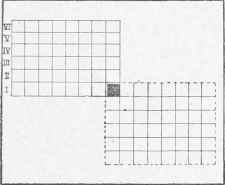
Postage Stamp Photographs.
Continue to:


My Books

