


Patterns For Tuyere Bend
Description
This section is from the book "Cassell's Cyclopaedia Of Mechanics", by Paul N. Hasluck. Also available from Amazon: Cassell's Cyclopaedia Of Mechanics.
Patterns For Tuyere Bend
The tuyere bend, of which Fig. 1 is a plan, is to be made in live segments, joined together with angle iron, each segment being made with four plates 1/4 in. thick. To obtain the pattern, first draw a plan of the bend, as Fig. 1, and then the semicircle ad on the end of the figure as shown. As the segments of the bend are to be each made in four pieces, the position of the seams may be fixed by making a b and c, d each equal to one-fourth of the end semicircle. Draw lines at right angles to A a3 from the division points b c to give the points a1 and a2; then, using 0 as centre and radius a1and a2, draw arcs of circles to show the position of the seams. Now divide the outer curve of one segment into any number of equal parts, as a, B, c, D, and E, and also divide the inner curve into a similar number of equal divisions; then join the points on the inner curve to the points on the outer curve, as A a3, B b3, etc. To work the pattern for the outside section of the bend, make the straight line ACE (Fig. 2) equal in length to the outer curve of the bend. From points A and E (Fig. 2) drop perpendicular lines, and make them equal in length to the arc of a circle be (Fig. 1). Draw a line from c (Fig. 2) parallel to AE to form the rectangle for the pattern (Fig. 3). The pattern for the inside section of the bend is worked in the same manner, a3 c3 e3 (Fig. 3) being equal in length to the inner curve (Fig. 1), and be (Fig. 3) being equal to b c (Fig. 2); the rectangle is formed complete by the samw method of working. For the side pattern, take 0 a2 (Fig. 1) as radius and draw an arc of a circle 0 a2 e2 (Fig. 4). Make a2 e2 equal in length to the curve a2 e2 (Fig. 1), and then mark off on the curve the divisions a2, b2, etc. (Fig. 4), transferring these from Fig. 1. Through 0 c2 (Fig. 4) draw the line c2c1on the pattern, and make the length from c2 to c1 equal to be (Fig. 2), or equal to one-fourth of the circumference of the end of the bend. Using this length as radius, and a2, b2, d2, e- (Fig. 4) alternately as centres, draw arcs of circles at the top of the figure. Now with a1b1 (Fig. 1) as radius, and using cl (Fig. 4) as centre, draw arcs of circles to cut those already drawn, and to give the points b1, d' (Fig. 4). With the same length as radius, and bl, d1 as centres, cut the two remaining arcs to give the points a1, el. Join a1 a2 and e1 e2 by straight lines, and then draw a curve to pass through the points a1, b1, c1, d', and e1, to complete the pattern.
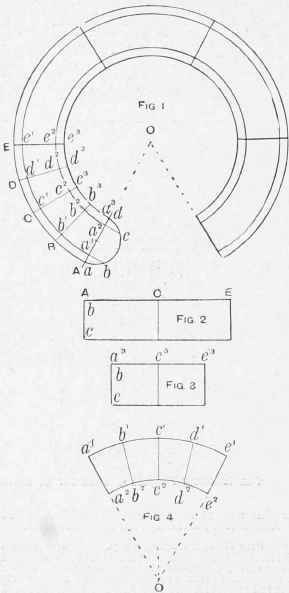
Patterns for Tuyere Bend.
Continue to:


My Books

