


Mounting Stereoscopic Photographs
Description
This section is from the book "Cassell's Cyclopaedia Of Mechanics", by Paul N. Hasluck. Also available from Amazon: Cassell's Cyclopaedia Of Mechanics.
Mounting Stereoscopic Photographs
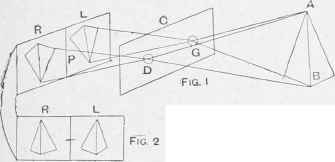
It is sometimes the case when viewing mounted stereoscopic prints that the objects in the background, when seen through the stereoscope, appear in front of the picture. The cause of this may be gathered from a consideration of the following principles. Let A B (Fig. 1) represent a pyramid and C the lens-board of a camera, with Lenses D and G forming inverted images R and L on the plate P. Supposing the operator to be standing behind the plate, the image formed by D at R will be similar to that seen by the right eye, and the image formed by G at L similar to that seen by the left eye. Now if a print be taken from this negative by placing a sheet of sensitive paper against the film it will be like Fig. 2 - that is, the left-hand view as seen by the left eye will now be on the right, because the images have been turned the right way up. Practically, the reason why the distant objects come forward is that the right eye is looking at the left eye view, and vice vers i, owing to the two views not having been transposed in mounting. In mounting stereoscopic prints, to prevent confusion, lay them face down, and run a short line across the back of the paper where the two prints join (see Fig. 2). Trim straight across the two prints for the base line and for the top. Now cut the prints in half and trim to about 2 3/4 in. square, leaving on the right of the right-hand print 1/4 in. more of the picture than appears on the left-hand print, and on the left of the left-hand print 1/4 in. more of the picture than appears on the right-hand print. Now mount the prints about 1/8 in. apart, with the half-lines on the outside of the print instead of being joined as they were before the print was cut.
Mounting Stereoscopic Photographs.
Continue to:


My Books

