


Mixing Pyro Developer
Description
This section is from the book "Cassell's Cyclopaedia Of Mechanics", by Paul N. Hasluck. Also available from Amazon: Cassell's Cyclopaedia Of Mechanics.
Mixing Pyro Developer
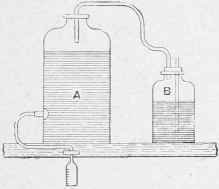
In mixing up pyro solution, some prefer to dissolve the pyro immediately before use, as, owing to its affinity for oxygen, it rapidly decomposes in water. This is, however, a somewhat tedious method of working, and often very inaccurate. As the pyro is extremely soluble, a small quantity of water only need be used, which, if previously rendered acid, allows of considerable storage. If a solution of pyrogallie acid and water be allowed to stand in a measure exposed to the air it will be noticed that, although the top of the solution actually coining in contact with the air rapidly oxidises and turns brown, the remainder is unaltered, proving that if the solution can be kept from the air it will keep considerably longer. An authority has suggested that the pyro bottle be fitted with an oxygen trap in the manner shown in the accompanying sketch. The pyro is kept in A and drawn off from the bottom as shown. The jar B contains a strong solution of pyro and sodinm sulphite, both of which readily absorb oxygen. The air that enters the jar B has to pass first through the solution, and a large proportion of oxygen is taken up. Both sulphite of soda and meta-bisulphite of potash are used as preservatives for pyro on account of their affinity for oxygen.
The latter is four times as strong as the former, but is more expensive and liable to make the pyro too acid. Another plan is to till a number of small bottles with a 10 per cent, solution of pyro and seal the tops with paraffin wax.
Mixing Pyro Developer.
Continue to:


My Books

