


Method Of Setting Out An Elliptic Arch
Description
This section is from the book "Cassell's Cyclopaedia Of Mechanics", by Paul N. Hasluck. Also available from Amazon: Cassell's Cyclopaedia Of Mechanics.
Method Of Setting Out An Elliptic Arch
In commencing to set out and turn an elliptic arch, the ellipse must first be set out by drawing a line A B(see Fig. l) equal to span of arch. Through centre of line raise a perpendicular C D equal to required height of arch (say 1/3). The foci of the ellipse are found by taking G as centre and the distance A D as radius, and describing an arc to cut A B at f1f2. The semi-ellipse may then be drawn by taking apiece of string equal in length to A B and fixing it by pins at f' and f2. Insert a pencil into the loop thus formed and draw the curve as at Fig. 1, taking care to keep the thread perfectly tight. To set out the stones forming the arch, divide the curve of the ellipse into the required number of equal parts (Fig. 2), and through each point draw lines from each of the foci, as at F. Bisect the angle EFG. The line which bisects the angle is a perpendicular to the curve. An arch constructed by this method will require every brick or stone to be of different shape in half the arch.
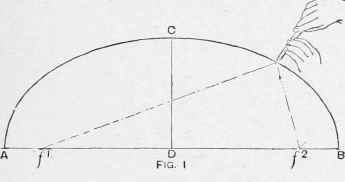
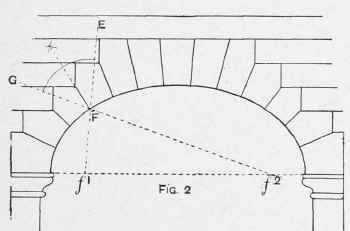
Setting out an Elliptic Arch.
Continue to:


My Books

