


Jewel Case With Secret Drawers
Description
This section is from the book "Cassell's Cyclopaedia Of Mechanics", by Paul N. Hasluck. Also available from Amazon: Cassell's Cyclopaedia Of Mechanics.
Jewel Case With Secret Drawers
The following instructions for making a .jewel case with secret drawers refer to one about 12 in. by 10 in. by Sin. Fig. 1 is a view of a jewel case when open; the carcase is put together with secret dovetail and mitred joints. The front or flap is mitre clamped and veneered on the face: the four drawers which the case contains are all hidden. The front A B (Fig. 1) is made in two parts, and represents the fronts of five drawers, A being made the height of drawers C, D, and E, whilst B is the height of drawer F and tray G. The bottom of G is a fixture, as are also the divisions between drawers F E, ED, DC; the front A is made as shown, with two scratch beads at equal distances. The bead M, which divides the front, is loose; to it are fixed two steel forks, which fit into the square mortises (Fig. 3); the two drawer knobs K K (Fig. 2) have a small square spindle attached, over which the steel fork passes, and fixed on the end of the spindle is an iron tongue and nut forming a turn-buckle. When the knob is turned so that the front is fixed, the fork K is dropped and fixes the front A, and, until lifted, the latter cannot be moved. N N are dowels fitted into the bottom of the case; the front B is made to work on pivots J J and is fixed by springs H H (Fig. 2). These springs are hidden by the silk lining of the tray, and, until released, the front a will not move; when the springs are released the front will fall on the bottom of tray G, giving access to the bead M. In a shallow case it will be necessary to form the movable knob at 0 0, or the forks L L will not draw out sufficiently to release the front A.
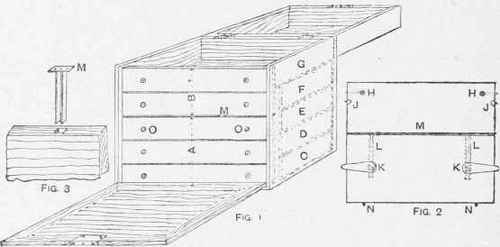
Jewel Case with Secret Drawers.
Continue to:


My Books

