


How To Make Leather Case For Croquet Mallet
Description
This section is from the book "Cassell's Cyclopaedia Of Mechanics", by Paul N. Hasluck. Also available from Amazon: Cassell's Cyclopaedia Of Mechanics.
How To Make Leather Case For Croquet Mallet
The leather for a croquet mallet case need not be very stout, but it must not be flimsy, unless it is backed with something, or it will wring in the sewing, and the handle portion will be unsightly. The leather used for the straps of bags, etc., will be suitable. Before cutting the leather, cut from stout cartridge paper a pattern to the shape of the mallet. Fig. 1 is the cover for the handle, which is 3 ft. long and 5 in. wide; Fig. 2 shows the cover for the mallet, which is 12 1/2 in. long by 13in. wide; while Fig. 3 is a pattern for the two ends, which is 3i in. wide by 4 1/2 in. deep. Two small ares are cut out of Fig. 1, as A, IS, so as to fit a hole I 6/8 in. diameter cut in Fig. 2 after it is curved to the outline of Fig. 3. In Fig. 2, l 1/2 in. is marked off at one side and the two corners are cut off, as C and D. The circular hole is then cut out, the centre being about 4 1/4 in. from the left-hand side, so as to be in the centre of the case when finished. In Fig. 3, l in. is allowed on top for a lap. The pieces E and F (Figs. 2 and 3) will form themselves into flaps if a piece is grooved out along the dotted line. To get the piece, Fig. 3, a good shape, cut an oblong piece to the measurements given above and fold it down the centre, and then cut off the corners G and H. Fig. 1 is now sewn into cylindrical form so as to take the handle, the circular piece, 14 in. diameter, as cut out of Fig. 2, being sewn to one end, the other end, with curves A and B (Fig. 1), being fitted into the socket hole at J (Fig. 4), and the straps and buckles sewn on at K and L. To give a good appearance to the case when finished, a little plush may be fixed in with glue paste; if desired, a cheaper lining can be used.
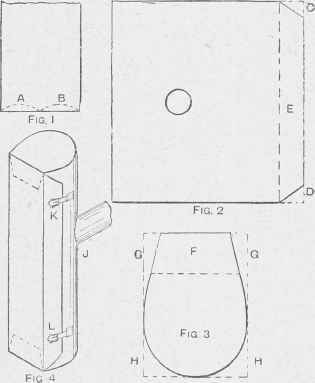
Making Leather Case for Croquet Mallet.
Continue to:


My Books

