


How To Make Flags
Description
This section is from the book "Cassell's Cyclopaedia Of Mechanics", by Paul N. Hasluck. Also available from Amazon: Cassell's Cyclopaedia Of Mechanics.
How To Make Flags
Flags are made of bunting joined by a double seam, the two edges being turned in. Sewing bunting cut diagonally is a rather awkward job. Silk is used for small and finer flags. Material may be economised by careful cutting; for example, the square of blue cut from the centre of the letter P (see illustration) will do for the centre square of the code letter S. The red circle from the pennant F will come in for the centre of the pennant C, the white circle from C for the circle in D, and so on. Paint and prints are not satisfactory for making flags. The illustration shows the distinguishing colours and forms of the code. The flag shown at the top left-hand corner is the code signal and answering pennant. The flag Q hoisted alone at the mainmast head signifies that the ship is in quarantine. The flag P hoisted alone at the foremast head signifies that the ship, if in dock, is about to sail that day; if in the fairway, that the ship wants a pilot.
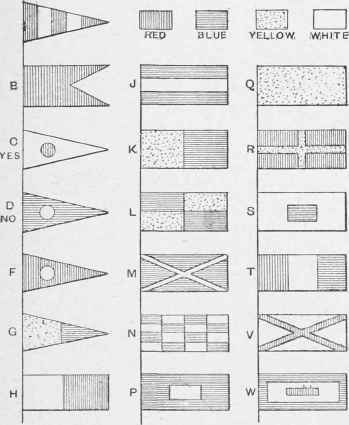
Signal Flags.
Continue to:


My Books

