


Enlarging With Pocket Kodak
Description
This section is from the book "Cassell's Cyclopaedia Of Mechanics", by Paul N. Hasluck. Also available from Amazon: Cassell's Cyclopaedia Of Mechanics.
Enlarging With Pocket Kodak
A pocket kodak camera may be used for enlarging, as shown in the sketch. A is a baseboard about 15 in. long by 6 1/2 in. wide. The exact dimensions will depend upon the size of the camera and the focus of the lens. A slot is cut at B to take a tongue C about 2 in. long. To this is fitted the adjustable negative (or film-holder) frame D. This runs in rails like a rising and cross front, and is clamped when in proper position by the thumbscrews E and F. On the inner side of this is a box G fitting closely inside the camera (film end). D is attached to C by the block H, which, resting upon the sides of A, holds everything firm and steady. At J is fitted the front of the enlarging camera, with the opening before the lens and a shallow frame P fitting closely around the kodak. (The kodak Q is, of course, supposed to be removed from its outer box.) Attached to the front by bellows R is a grooved frame K large enough to take a half-plate printing frame - that is, about 8 in. by 6iin. Through this from the frame runs an iron or brass rod L, over which a staple U may be turned to clamp it and thus hold the frame K tightly in position.
When a film is used it is fixed, to keep it flat, between two pieces of glass and inserted in frame D, the film towards K. A sheet of ground glass is then placed in the printing frame, the rough sided the glass towards the operator, and the frame is placed in the grooves S of K, which is then extended almost to the full. D is next extended until the image thrown on the ground glass is nearly sharp. The tine focussing is done by manipulating K. It is then clamped by U over L. Adjust finally in position by screws E and F. Now replace the ground glass with plain glass and place against it the film side of the bromide paper or plate, and rill in the frame back. Cover the enlarging camera with a thick dark cloth and burn some magnesium ribbon before D. The bromide paper is then developed like a contact print. If only one degree of enlargement is required, the bellows may be replaced by a rigid box.
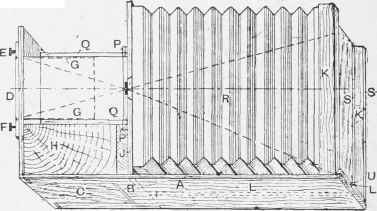
Enlarging with Pocket Kodak.
Continue to:


My Books

