


Enlarging Photographs By Daylight
Description
This section is from the book "Cassell's Cyclopaedia Of Mechanics", by Paul N. Hasluck. Also available from Amazon: Cassell's Cyclopaedia Of Mechanics.
Enlarging Photographs By Daylight
For making enlargements by utilising the window of a dark room, construct a bracket A (see illustration) and an upright easel B, running in guiding rails X. Outside the window hinge a reflector D, consisting of a white board about 24 in. by 20 in., held at an angle of 45' with the window sash by a cord s passing through the joint of the window frame. The camera C, preferably one with a movement of front for focussing or a lens with rack and pinion, is placed on the bracket as shown. The ground glass of its focussing screen may be removed and the negative inserted in its stead, or a carrier may be made to fit the slide grooves. Another plan is to place the negative in the dark slide, removing the partition and withdrawing both shutters. The size of the enlargement will depend on the distance of the easel from the negative and the amount of extension of the camera. The finer focussing having been done on a sheet of white paper, make a cap of ruby glass to fit over the lens, pin up the bromide paper on the easel, and, if the position is correct, remove the cap and expose.
Light must reach the easel only through the negative.
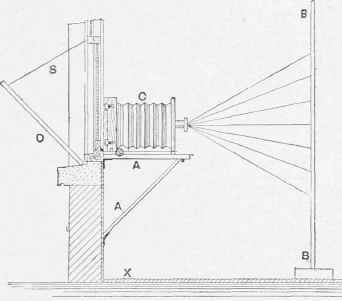
Enlarging Photographs by Daylight.
Continue to:


My Books

