


Development Of Spiral Flute On A Column
Description
This section is from the book "Cassell's Cyclopaedia Of Mechanics", by Paul N. Hasluck. Also available from Amazon: Cassell's Cyclopaedia Of Mechanics.
Development Of Spiral Flute On A Column
If a piece of paper be cut to the shape of a right-angled triangle and wound round a cylinder, the top edge forms a helix or spiral line, as in the accompanying illustration. The larger the angle A, the steeper the pitch of the spiral. The simplest method of developing a spiral flute would be to first dress the shaft of the column to a cylindrical surface, then mark off the base of each flute at the lower end, cut a piece of brown pa petto triangular shape to give the required pitch, wind it round the column and pencil the outline formed by the top edge. The pitch is found by making the length of the triangle equal to the circumference of the shaft, and the height of the triangle equal to the height the spiral is required to rise in one revolution.
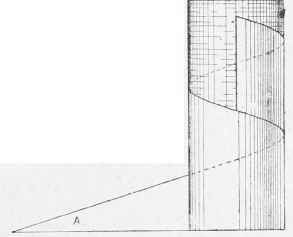
Development of Spiral Flute on a Column.
Continue to:


My Books

