


Depthing Watch Lever Escapement
Description
This section is from the book "Cassell's Cyclopaedia Of Mechanics", by Paul N. Hasluck. Also available from Amazon: Cassell's Cyclopaedia Of Mechanics.
Depthing Watch Lever Escapement
Escapements are "pitched" by putting the escape wheel and the pallets in a "depth tool" and adjusting them until correct, then transferring the depth to the watch plates by means of the compass points of the tool, and drilling the pivot holes at the points indicated. The roller depth is pitched by placing the roller on a turning arbor in the depth tool with the lever. The pallet depth is correct when the wheel teeth just fall upon the Locking faces of the pallets. If the teeth fall upon the impulse planes, the depth is shallow. This depth can he tested in the watch by holding the movement in the left hand with the tip of the forefinger on the balance. In the right hand hold a sharpened watch peg, with which press gently on the 'scape-wheel teeth, urging the wheel forward. With the forefinger of the left hand, slowly lead the balance round until a tooth just drops. Immediately letthebalauce go, and, if it has locked properly, the lever will be drawn sharply up to the banking pin; if it is too shallow, the lever will go back and the watch will tick rapidly. This requires some practice to test, but perhaps the above sketches will be helpful.
A shows a tooth locked, having just dropped on to the pallet, and a correct depth, l; shows a shallow depth, the tooth just missing the corner of the pallet and falling on to the impulse face instead. C shows a deep depth, the tooth falling too far on the locking face.
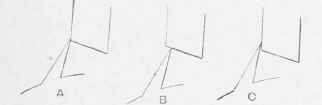
Depthing Watch Lever Escapement.
Continue to:


My Books

