


Construction Of Small Panelled Doors
Description
This section is from the book "Cassell's Cyclopaedia Of Mechanics", by Paul N. Hasluck. Also available from Amazon: Cassell's Cyclopaedia Of Mechanics.
Construction Of Small Panelled Doors
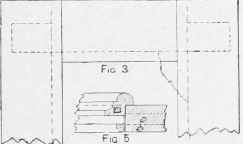
Joiners and cabinet makers have different methods of constructing small doors. Fig. 1 shows part of the elevation of a plain one-panel door, as made usually by the joiner. Fig. 2 shows the ends with the stiles in section, the dotted lines indicating, as in Fig. 1, the positions of the panel and tenons. It will be seen that the panel is in grooves worked on the inner edge of each piece of wood forming the frame, and that, once together, the panel is fixed so that it cannot be removed. Figs. 3 and 4 show the cabinet-maker's method; movable panels are used, the inner and back angle of each piece of wood forming the door being rebated. The panel can then be removed by unfixing the beads shown in Fig. 4. It is obvious from this that the advantage of this construction is considerable in French-polished articles. In cases where a raised or bolection moulding is used, as in Fig. 5, no rebate is necessary. The mortises and tenons of cabinet work are rarely cut through, as less exposure to damp renders this less needful, and a better appearance is secured when the ends of tenons are not visible.

Fig. 2.
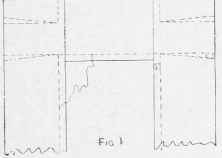

Fig. 4.
Construction of Small Panelled Doors.
Continue to:


My Books

