


Bending Small Tubes
Description
This section is from the book "Cassell's Cyclopaedia Of Mechanics", by Paul N. Hasluck. Also available from Amazon: Cassell's Cyclopaedia Of Mechanics.
Bending Small Tubes
To bend a number of pieces of, say, |-in. brass tube as A (Fig. 1), cut a piece of hardwood as oak or beech, 1 in. thick, to the curve required, and in it drill a small hole B. In this hole one end of the tube is inserted; the tube is then bent round the block. Before this, however, one end of the tube should be stopped, or it may be pinched in the vice. It should then be filled either with melted resin and pitch or lead, the latter being the better, as the tube is less likely to buckle. Several lengths of tube may be bound together with wire and annealed at the blowpipe or forge. The seam of the tube must be inside the bend. A bender which has a movable block E is shown in Fig. 2. The base F may be 1-in. or 1 1/2-in. deal, but the piece C should be of 3/4-in. oak, beech, or similar hardwood firmly screwed to the base. A strip of iron D, 1 1/4 in. wide by 1/8 in. thick, is screwed, and a hole drilled in it serves to hold the tube firmly while being bent. The piece E has two 3/8-in. iron pins tightly driven in and projecting 3/4in. as shown, holes being drilled for these in the baseboard. First insert an end of the tube in the iron strip and bend the tube round and underneath; then put the block E in place and bend the tube round it as indicated. A piece of wood 6in. long, Sin. wide, and lin. thick is screwed in the centre of the baseboard underneath and is pinched in the vice; it holds the block firmly while being used. Brass wire may also be bent by the same means, but the blocks need not then be so strongly made. Brass rings can be made with a parallel iron mandrel; on this the wire is wound. It can then be taken off and cut up with a circular saw, and brazed or otherwise joined.
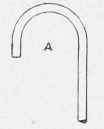
Fig. I.
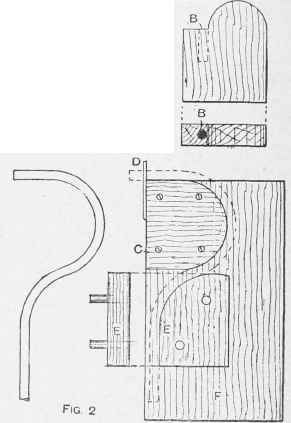
Bending Small Tubes.
Continue to:


My Books

