


Ascertaining Strength Of Timber
Description
This section is from the book "Cassell's Cyclopaedia Of Mechanics", by Paul N. Hasluck. Also available from Amazon: Cassell's Cyclopaedia Of Mechanics.
Ascertaining Strength Of Timber
The machines used for testing the tensional, compressional, and other strengths of timber and other materials are very elaborate and very expensive, as the experiments must be efficiently carried out. In testing for tensile strength, the piece of timber may be from 1/2 in. to 3 in. square, held between toothed jaws, or shouldered and held between clips, but it is essential that the stress should be direct, that is, in the true axial line of the piece. The same sizes maybe used for testiug compressive strength, the ends being made perfectly true and square, and not shouldered. Timber is, however, more often tested for transverse strength, and home experiments may be made which will give a rough approximation. What is wanted is to find a value for c in the formula W = cbd2/L , where W is the breaking load.e a co-efficient varying with the material and the mode of loading and supporting, b the breadth in inches, d- the deptli in inches squared, and L the clear span in feet. If the piece be simply supported at both ends and loaded in the centre, c will be about 3 1/2 cwt. or 400 lb. for fir or deal. .Say a piece of straight yellow deal, Jin. square and 3 ft. long, carefully prepared, and laid across two supports fixed level at a distance of 24 in. from each other, and an empty galvanised iron bucket hung on the centre of the beam.
Then the bucket can be gently filled with dry sand until the small timber beam cracks and breaks. It can be arranged that the bucket does not fall far, and then the bucket and sand can be carefully weighed. Suppose it to be 801b., then the calculation will be 80 = c x ( .75x.752)/2 ;80 = c x .2109; c = 8/.2109= say 330 lb. or 330/112 = say 3.4 cwt. If the timber con tains moisture from want of seasoning or otherwise, the fibres will tend to slide on one another and yield with a smaller load. The effect of this moisture may be shown by plotting the results to a curve, as in the illustration herewith, which is hypothetical only.
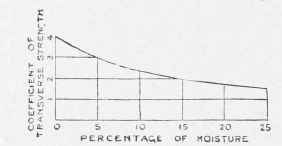
Ascertaining Strength of Timber.
Continue to:


My Books

