


A Combined Jewel Box And Scent Cabinet
Description
This section is from the book "Cassell's Cyclopaedia Of Mechanics", by Paul N. Hasluck. Also available from Amazon: Cassell's Cyclopaedia Of Mechanics.
A Combined Jewel Box And Scent Cabinet
Fig. 1 shows a cabinet constructed to contain jewellery in the front and at the back scent bottles which are fixed by contact with the lid. To lock the bottles, they must fit their sockets. The doors or lids of the cabinet are framed and glazed. Fig. 2 is a plan with the lids removed to expose part of the interior. The back of the box is joined to the front by a partition B, which is detailed in Fig. 5. The framework is of 3/8 in. stuff, 3 1/8in. wide, the sides being mitred together. Before fitting the parts together the grooves for the various partitions should be made. The groove for the partition B (Figs. 2 and 3) should be 4 3/4in. from the front and 1/8 in- deep, whilst for the pieces C (Fig. 3) the grooves should be 1 3/4 in. from the front, and only 1/16in. deep. Fig. 3 is a plan with the top tray removed. The front F (Figs. 2 and 3) has two grooves 1/16in. deep by 3/16in., one for D (Fig. 3), the other for El 17/8in. from the left-hand end. These grooves run only 15/16in. from the bottom. The bottom must have a groove 1/4in. wide for B, and another 3/16 in. wide for the rails C (see Fig. 4); at right angles are grooves for D and E. The fixing screws for the base are hidden by a moulding (see Fig. 4). The partition D (Figs. 3, 4, and 6) stands up Jin., allowing 1/16fin. for the groove in the bottom. The left-hand cross rail C, with its 3/16-in. groove, is shown separately in Fig. 7. The right-hand rail is without a groove (see Fig. 3). The top tray, shown in Fig. 2, is made from two pieces 8jin. long, l 3/4in. wide, and 3/16in thick, and two similar pieces 4 3/8in. long. The bottom is 1/8 in. thick, let in as shown in Fig. 4. The back strip, with grooves 1/16in-deep and 3/16in. wide, is shown separately in Fig. 8. The front (Fig. 9) is almost similar. The left-hand side of the tray should have a ,',,-in. groove for the rail G (Fig. 2). The partitions may simply be nailed in from the bottom. Fig. 10 shows the short rail G, with two grooves 3/16: in. wide, to take the short rails H (Fig. 2). The cross rails P (Fig. 2) are 41 in. long, 1 3/4 iu. wide, and 3/16 in. thick. The top tray rests on two rails LL (Fig. 3) 4 3/8 in. long and 3/16in. square, nailed to the sides. The two vertical pieces M (Figs. 1, 2, and 3) are 2 7/8 in. wide, a in. thick, and 6 1/2 in. long. Pieces are cut away at the bottom of these, and also at the bach of the side rails A (Fig. 2), similar to halving, so that these pieces can he fixed by screws from the inside. Or they may be dovetailed into the sides. The tops are curved (see Fig. !'. and the bop rail x (Fig. 1) maybe fixed at the ends by two tenons. The doors are mitred together, the framework being , in. wide and 4 1/2 in. long for the top ami bottom and 5 1/2 in. for the sides, whilsl the thickness is 1/4 in. The glass is let in in the usual manner. The doors are hinged to the sides. Under the two pieces 0 0 (Fig. I) and near the centre are two small pins in the partition B (Figs. 2 and 3) to give the doors rigidity when locked from the front. The interior of the: tray should be covered with silk velvet, which in the case of the bottom part, or under the tray, should simply be fixed by means of a little thin glue. The appearance of the top tray would be greatly impi-oved if the sides were padded with cotton wool or wadding. The two larger compartments to the left of the top tray (see Fig. 2) may each hold a watch, and a thin wedge-shaped piece with a hole in the centre should be glued in and covered. Fig. 11 is a detail of the right-hand partition P (Fig. 2). For removal of the top tray, fix two tabs or strings to the sides. Walnut, when polished, looks well as a wood for this cabinet.
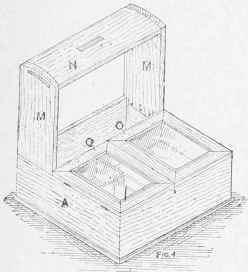
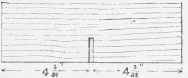
Fig. 5.
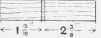
Fig. 6.

Fig. 7.
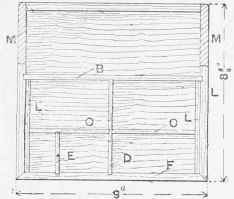
Fig. 3.
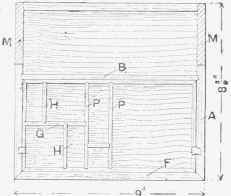
Fig. 2.
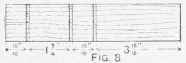
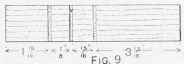

Fig. 10.

Fig. 11.
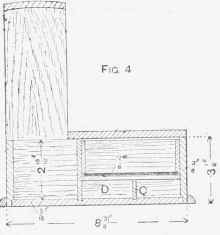
A Combined Jewel Box and Scent Cabinet.
Continue to:


My Books

