


Selection Of Compound Wheels
Description
This section is from the book "The Mechanician, A Treatise On The Construction And Manipulation Of Tools", by Cameron Knight. Also available from Amazon: The mechanician: A treatise on the construction and manipulation of tools.
Selection Of Compound Wheels
In order to select four compound wheels to cut a stated pitch, the first and second terms should be treated in a manner similar to that described for simple gear. But when calculating for a set of compound wheels, the whole of the factors or symbols belonging to the fractions are vised, both numerators and denominators. For instance, select the first example in the tabular set just given, which requires a screw of 6 per inch to be cut with a screw of 2 per inch. The two integral symbols 2 and 6 are put into their simplest fractional forms 2/1 and 6/1, and all the four are multiplied by 20, thus :
2 x 20 = 40 6 x 20 = 120
- -
1 x 20 = 20. 1 x 20 = 20.
The four products which result are the numbers of four wheels that would cut the thread; therefore inspect them and see if they are available. In some cases they would be unsuitable, because the lathe does not possess two 20-wheels ; so that the four factors are to be multiplied by some other number, or two numbers, such as 25 and 20, which give these products :
2 x 25 = 50 6 x 20 = 120
- -
1 x 25 = 25 1 x 20 = 20.
The four wheels thus indicated are 20, 50, 25, and 120, which are always available. Those two which are to be drivers are 20 and 50, and produce a smaller product, when multiplied together, than the driven wheels indicated by 25 and 120, because the screw to be cut is of finer pitch than the lathe-screw. If the intended screw were to have 2 per inch, and to be cut with a lathe-screw of 6 per inch - the reverse of the example - 20 and 50 would be driven wheels, and 25 and 120 would be drivers. When the numbers of wheels are obtained by multiplying the two terms in the above relative situations, the two drivers and two driven ones are always diagonally situated opposite each other, because the relation between the lathe screw and required screw is divided between two drivers and two driven wheels, instead of between one driver and one driven.
The pitch 2.3 per inch to be cut with a screw of 1.8 is to be next treated, which was mentioned in the section on selecting simple wheels. The two terms, when reduced, are:
18/10 23/10
:
By now multiplying 18 and 10, each by 23, and both 23 and 10 by 5, these are produced:
25 and 115 denoting the driven wheels, and 45 and 50 the drivers.
3c
Proceed next to select wheels for 6 1/4 per inch, the lathe-screw being 2 per inch. The symbols, when changed to quarters, appear thus:
8/4 25/4
The two left-hand figures are to be now multiplied by 10, and the two right-hand ones by 5, which produce 20 and 80 as drivers, and 40 and 125 as driven wheels, each one being here shown distinct from its fractional symbol:
It is to be remembered that the two terms by themselves alone, when put into fractional forms, indicate four wheels which would cut the thread; and if a large quantity of wheels were provided whose numbers advance by ones, instead of fives, it would not be necessary to multiply any of the figures, because the same relation exists between 4 and 8 as exists between 40 and 80, and the same exists between 4 and 25 as between 20 and 125.
It is now required to cut a thread with 5/9 of a step per inch, the lathe-screw having 1 5/7 in an inch. In this case, the 5/9 needs no reducing, being already in a fractional form; but the If is to be changed into 13/7, after which the two terms are placed as in other cases, and multiplied by 5 and 10, as here represented:
13 x 5 = 65 5 x 10 = 50
- -
7 x 5 = 35 9 x 10 = 90.
Consequently, 35 and 50 are driven wheels, and 65 and 90 are drivers, which will produce the intended thread with 5/9 per inch.
In many cases the threads are denoted with decimals instead of vulgar fractions. In such case the two terms, together with their decimals, are to be put into improper fractions by ordinary arithmetic, and are then used as before directed. Suppose a thread of 2.75 per inch is wanted, and a screw of 2 per inch is to be used, both the terms are put thus:
200/100 275/100
After which the four factors are divided by 4 and 5, and these products obtained:
200/ 4 = 50 275 /5 = 55
- -
100/ 4 = 25 100 /5 = 20.
25 and 55 are therefore the driven wheels, and 20 and 50 the drivers. From this example it may be seen that the process of dividing by any numbers which suit the wheels is as effective as multiplying. Division is resorted to when several figures appear in each term, and multiplication when only one or two. Another example in which division is involved is now given, which need not be further explained:
Steps per inch of Steps per inch in Screw
Lathe-screw.
: 3.625; or, in improper fractions,
2000/ 40 = 50 3625/ 25 = 145
1000/ 40 = 25 1000/ 25 = 40.
It is now required to cut a long lathe-screw with one step per centimetre, and using a lathe-screw of 2 per inch. The two terms, previous to being changed to vulgar fractions, are indicated in this manner: because 2.539954 is the quantity of centimetres in one inch. When in the fractional forms, ready to be divided, they are indicated in this manner:
1000000 / 500000 : 1269977 / 500000
The fraction is in its simplest form, and obtained by dividing the fraction of by 2, beyond which it cannot be reduced, and changing the term into an improper fraction by the ordinary arithmetical method. Similarly the fraction is obtained by multiplying 2, the pitch of the lathe-screw, by 500000. After this, all the four are divided, the two left-hand ones by 20000, and the two right-hand ones by 10000, because such numbers suit the screwing-wheels. This gives the result here indicated :
1000000 / 20000 = 50 1269977 / 10000 = 126.9977
500000 / 20000 = 25 500000 / 10000 = 50.
By this we see that 25 and 127 are driven wheels, and that 50 and 50 are drivers. The .9977 of a tooth is considered as one tooth, and by using the set indicated no error can be appreciated in a length of 100 inches; consequently, the wheels are absolutely correct for all practical purposes; and only the 127-wheel requires to be made in addition to those in ordinary use. It must be observed that a considerable difference exists between the lathe-screws which are said to have 2 steps per inch. Therefore a correct screw of great length with 1 centimeter step cannot be cut except with a screw possessing exactly two steps per inch along its entire length, and every inch equal to 2.539954 centimetres.
Concerning this screw of 1 centimetre step, it is proper to refer to the section on selecting simple wheels, in which it is stated that the two numerators of two improper fractions by themselves alone indicate the wheels required. Suppose we now take away the 1000000 and the 1269977, and divide each by 10000, we get this result:
1000000 / 10000 = 100, and 1269977 / 10000 = 126.9977. By this we see that a 100-wheel on the mandril, if there is room for it, in conjunction with the 127-wheel on the screw, will cut the same pitch as the four wheels before indicated.
It is next requisite to give the method whereby any set of wheels can be proved correct for a stated pitch. The rule is: Multiply the driven wheel or wheels together, and also the driving wheel or wheels together; then divide the product of the driven wheels by the product of the drivers, and multiply the quotient thus obtained by the pitch of the lathe-screw. If this product is the same as the pitch desired, the wheels are the right ones. For instance, What pitch can be cut with 127 and 25 as driven wheels, and 50 and 50 as drivers, the lathe-screw having 2 per inch? The result is thus obtained:
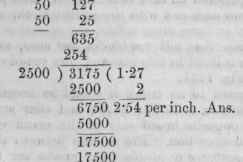
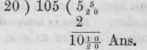
It is thus seen that the quotient 1.27 x 2 equals 2.54 per inch, which will be the pitch produced. What pitch will be cut with 105 as a driven wheel, and 20 as driver, the lathe-screw having 2 per inch ? In this case the operation is very short, the driven wheel being immediately divided by the driver, as here seen :
What pitch will 35 cut as driven wheel with 80 as driver, the screw being 2 an inch?
80 ) 350 ( .4375 320___2
300 .8750 Ana,
600 560
400 400 What step will be cut with a screw-wheel of 45, and a mandril-wheel of 60, the screw possessing 1*5 per inch?
60 ) 450 ( .75 420 1.5
300 375 300 75
1.125 Ans.
Continue to:


My Books

