


Part I. Chapter I. Forging
Description
This section is from the book "The Mechanician, A Treatise On The Construction And Manipulation Of Tools", by Cameron Knight. Also available from Amazon: The mechanician: A treatise on the construction and manipulation of tools.
Part I. Chapter I. Forging
The importance of good forgings in engine-machinery cannot be properly estimated except by those who have been intimately connected with engine-making. All the working portions of an engine that are intended to sustain the greatest strain must be forged. A few years since, engineers used cast iron for such purposes, and, in order to obtain sufficient strength, made use of large masses of metal; thus ensuring a certain, or rather uncertain, amount of safety. However large a lever or shaft may be, there is always attending it some disagreeable apprehension of danger, if it is made of cast iron, and the suddenness of the break is almost certain ; but, with forged iron, an instantaneous break, without some previous sign of approaching rupture, is extremely rare. Such a division may possibly occur if the shaft, lever, or rod is made too small; and there is also a small liability to such an occurrence with shafts that are too large. A well-proportioned forged shaft or lever may be so much injured by improper hammering as to render it liable to break with less than the ordinary wear and strain allotted to it. Good soft iron, of well-defined fibrous character, may, by hammering, be made crystalline, and will become as untrustworthy as the cast iron from which it was originally made.
The outside dimensions of a forging often convey an incorrect idea of its internal strength; and no engineer, however penetrating, can, by measuring a certain shaft or lever, ascertain whether it is strong enough for the engine of which it is a part; neither can he point out its weakest spot. The smith who made it should know much more about the strength of his forging than any other inspector ; but smiths generally do not know. A good smith is a rare individual. He knows that the fibres of the iron must be so arranged as to be in proper position for sustaining the strain; and having succeeded in obtaining a proper arrangement of the fibres, he will not change them into crystals by improper hammering.
A smith is a much more important individual than a member of any other branch of engine-making. Planers, fitters, and turners are more dependent upon mechanical contrivances than smiths. An intelligent turner can very soon learn all that is needful for his business; but a good smith is more original and prescient than a member of any other branch. Much more time is required to make a good smith than to make a good planer or turner.
It is, however, proper to admit that the engine-smith of the present day is not generally so original or ingenious as the smith of olden time. An inferior smith can now produce good work in large quantities, in consequence of the great aid afforded him by various inventions for reducing the amount of labour, these inventions being the productions of studious mechanical men who are not necessarily smiths in the usual meaning of the term ; but by placing a modern smith upon an equality with one of old, without recent inventions, we discover the amount of ingenuity in each.
Probably in a few years the forging process will become quite as mechanical as planing, slotting, or turning, at which time the present foresight, skill, and labour accompanying forging will be almost dispensed with ; but, until forging machinery becomes general, the smith must continue to exercise his present amount of care, discretion, and skill.
The number of forging-machines is at the present moment very considerable, and some of them produce better work than can be made by any kind of mere hand-labour, unless an intolerably large amount of time is consumed during the process. We now have a variety of machines for producing forgings by compression, bolt-machines, nut-machines, a great number of rolling-machines, a variety of steam hammers, including the new patent steam striker and what is named the rotary hammer. All these are daily becoming more intimately associated with smith's work of all kinds, large and small. Even at the present time, all those forging machines that act by compression and cutting dies, can be adapted to produce all the necessary forgings for small engine-work, and we may reasonably expect to obtain machines each more and more varied in application than the preceding ; and the works produced will be more and more the result of machinery, till the smith's hand-labour and intellectual energy now required for his work be reduced to a minimum. Probably, at the time the minimum of labour is reached, we shall reach the maximum of good quality. By referring to other branches of engine-making, such as turning or planing, we discover that every mechanical contrivance introduced to diminish labour, at the same time increases the good quality of the work produced. We may thus infer that similar things will occur in the noble art of forging.
The advantage of a tolerable knowledge of smith's work to engineers is hereby made apparent to readers generally ; some remarks may therefore be submitted to students who wish to acquire some knowledge of the internal structure of the various pieces of machinery, and not merely how to shape their outsides.
Although we know that mechanical contrivances will become more and more extensively applied to forgings of all kinds, we do not anticipate any change in the circumstances that determine or control the production of good, sound work.
With relation to a good piece of smith's work, three principal circumstances require consideration. These are, the outside dimensions of the article when finished, the arrangement of its component fibres, and the amount of wear and tear to which the article will be subjected when in ordinary use.
The outside dimensions of a forging are ascertained by ordinary calculation, after it is decided to what purpose the engine, machine, or lathe is to be applied.
The position of the constituent fibres of separate forgings, and the several duties to be expected from them, shall now be considered.
This work is designed to be useful to those who are now actually working at the business, and also to those who intend to become practically acquainted with it. It is therefore proposed that all our younger readers first devote some careful attention to the forms and names of the forgings that are used in engine-making. A correct knowledge of names is very important to all beginners in engineering; consequently a number of outlines of forms are introduced immediately connected with their corresponding names. See Plates 1, 2, 3.
Plate 1

Plate 2

Plate 3
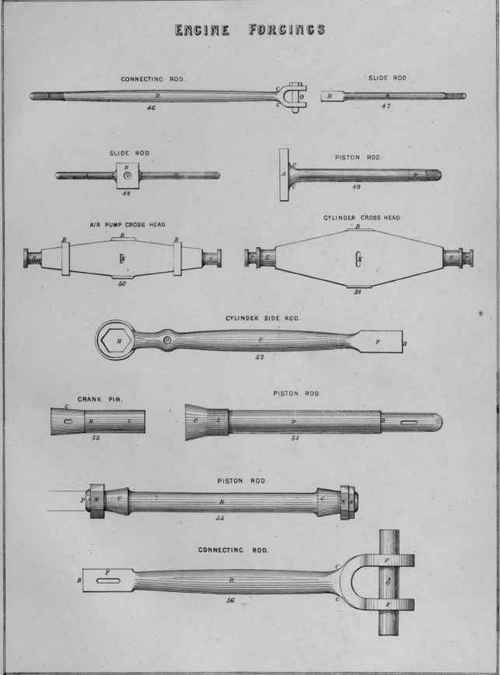
After examining a few of the figures of Plate 1, the student is directed to the technical phrases here introduced.
Continue to:


My Books

