


Modes Of Fixing For Planing
Description
This section is from the book "The Mechanician, A Treatise On The Construction And Manipulation Of Tools", by Cameron Knight. Also available from Amazon: The mechanician: A treatise on the construction and manipulation of tools.
Modes Of Fixing For Planing
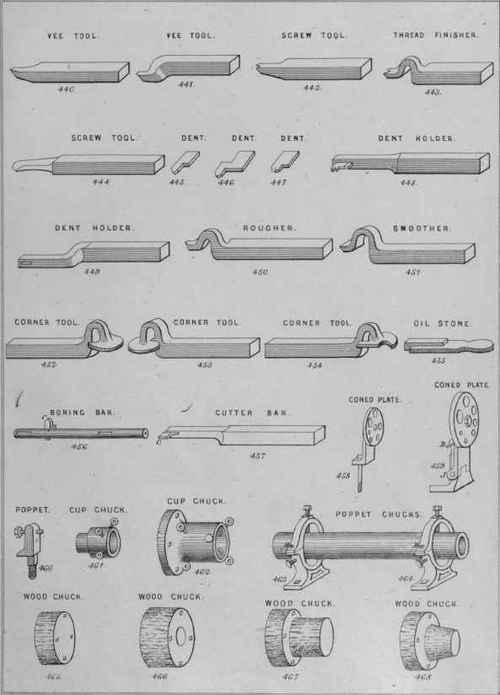
Having mentioned several modes of planing and lining, also the machines and implements required for planing, it is now presumed that a planing-machine and its instruments are available for having objects attached. Methods of properly placing objects, are here given ; and it will be afterwards necessary to introduce such cutting-tools as are useful for planing, in addition to the slide-rest tools shown in Plates 33 and 34, and described in page 130.
Plate 33
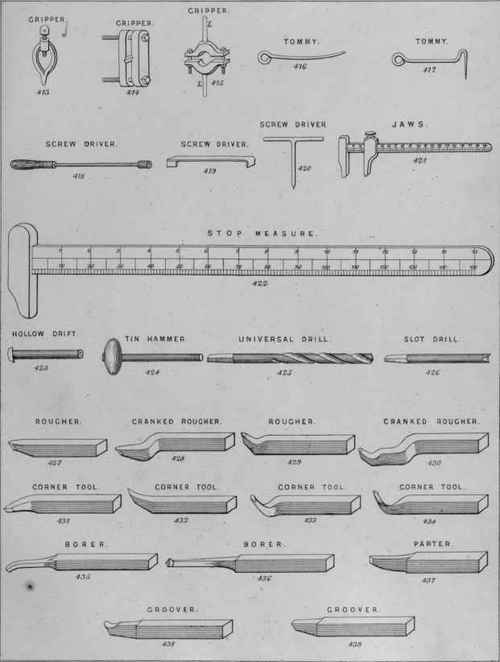
Plate 34

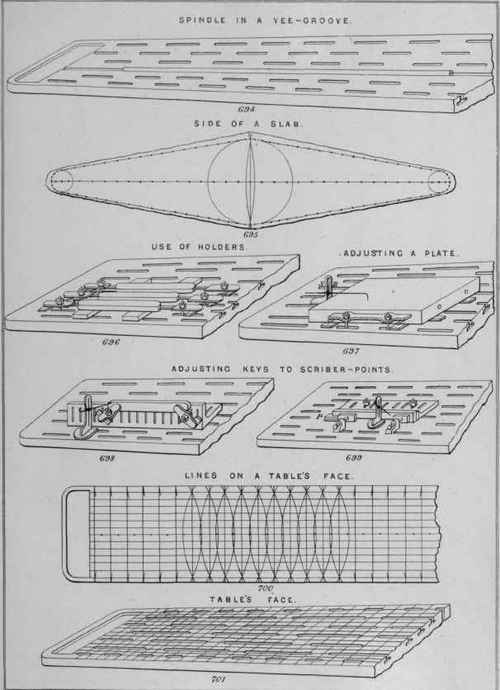
A number of general appliances for attaching the various articles, are indicated in Plates 51 and 52 ; in which the front edge of the table, whether of a shaping-machine, or of a planing-machine, is the edge situated in the front of each Figure ; consequently the relative situations of the objects on the tables are perceived by inspection. Those who have not noticed which is the front edge of a planing-table, may see it named in Fig. 653, and at this edge the workman stands during the attaching and adjusting processes to be given.
Plate 51
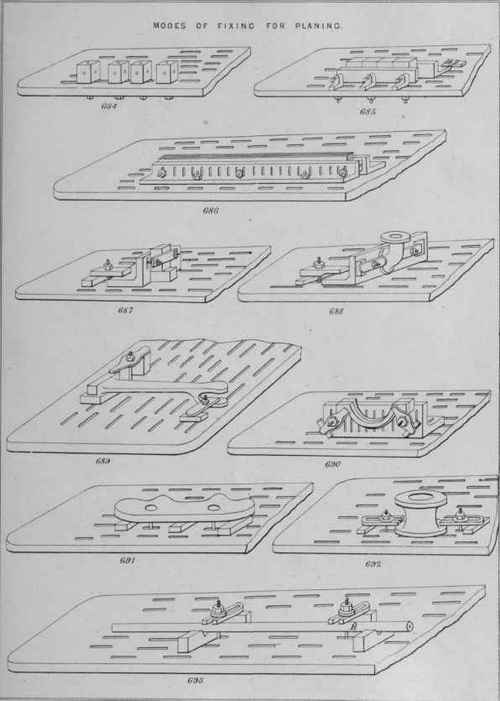
Plate 52
Right-angled blocks are quickly and accurately made in large numbers by the aid of machine-planing, and the making commences by first carefully planing a long steel bar on its four sides, to make it parallel and right angular, after which it is cut into short pieces, each being long enough for one block. Two, three, six, or any required number of such pieces, are next put together and fixed on a planing-table, to adjust the roughly-cut ends to make all the blocks of a proper length, and right angular to the four previously planed surfaces. A few blocks of this sort may be fastened against an el-chuck, by means of a thick plate and three or four poppets, as shown in Fig. 685. While in this situation, the upper ends of the blocks are planed, and they are next put upside-down and again fixed for planing the other ends. Right-angled blocks are very useful if provided with screwed holes ; such holes are drilled and tapped after each block is carefully forged, cast, or otherways made right angular; but previous to being finally smoothed to the shape. When the holes are finished, the blocks can be fixed to a planing-table with screw-bolts, as shown in Fig. 684, and adjusted to very accurate shape and dimensions by taking off very thin slices after each fixing. During such planing, an outside calliper and an el-square are required, and if carefully used, but little filing and scraping afterwards, to finish the blocks, will be necessary.
Some blocks for packing and lining have only two sides of each block planed and made parallel; these are called parallel blocks. Right angled blocks and parallel blocks should never be cubes, except for special purposes; every one should have three dimensions differing considerably from each other, to make them suit a variety of work. Consequently, a bar two feet in length, to be cut into blocks, may be three or four inches -wide, and about an inch thick. By cutting such a bar into lengths of three-quarters, one inch, one and a half, two inches, and two and a half, a great variety of sizes are obtained of one bar.
Fig. 686 indicates an appliance for planing edges and sides of long slender bars, rods, plates, straight-edges, twist-finders, and similar objects. By this plan, two el-chucks are used, which are bolted to the table, and also drawn towards each other with the work between, by means of three or four screw-bolts and nuts, the bolts for gripping the work extending through the slots or holes in the el-chucks. The thin pieces to be planed are above these bolts, and are raised to a proper height to clear the bolts, by resting on parallel packing blocks of a suitable height, and placed between the two chucks. The thin pieces are thus held until the upper edges are planed, when all are put upside down, and again fixed to plane the other edges. Straight-edges and other thin bars, may also be planed between an el-chuck and a thick plate tightened with poppets, as denoted in Fig. 685.
To plane a right angled block singly, if it is without any screwed holes, it is put against an el-chuck of proper height, and held with a plate, or two plates, and bolts, as in Fig. 687, the piece to be planed resting on a packing block beneath, and in contact with the table's face.
A tubular elbow which requires its two flanges to be at right angles to each other, is also conveniently planed while fastened to an el-chuck, as indicated in Fig. 688; and when it is requisite to plane the flanges at some other angle than a ninety, the el-chuck is easily wedged up at one edge, to place the flanges into the required position.
The first fixing of a tee-end excentric bar is shown in Fig. 689, which represents the length of the bar to be across the table, that the curved corner near the tee-part may be easily finished. All this upper surface is smoothly finished by means of a primary line along the middle of the bar's edge, similar to other such lines before mentioned, and the bar is also adjusted by this line, with blocks or wedges under the tee-part. In addition to the holdfast plates shown, another is required at the other end of the tee-part, and a plate is also required opposite the one in the fork-gap ; and when all the upper surface of the intermediate portion is shaped, the plates are removed from the tee-part and put upon the mid portion, that the upper side of the tee-head may be planed. This completes all the planing that can be done with one fixing; the bar is next put upside down, and upon parallel blocks, to plane the opposite side; after Avhich, the bar is fined on its planed side, and fixed edgeways on blocks, or fixed with its planed sides against an el-chuck, to plane the bar's edges.
Continue to:


My Books

