


Science Stunts
Description
This section is from the book "Boy's Fun Book Of Things To Make And Do", by Grosset & Dunlap Publishers. Also see: The Pocket Dangerous Book for Boys: Things to Do.
Science Stunts
INTERESTING electrical experiments are pos-sible with either a spark coil from a Model-T Ford or a small neon-sign transformer. On the Ford coil, the end terminal is one of the primary terminals, and the top terminal nearest the end-terminal end is used jointly for the other primary terminal and the inner terminal of the secondary. To help prevent a shock, connect this secondary terminal to your apparatus.
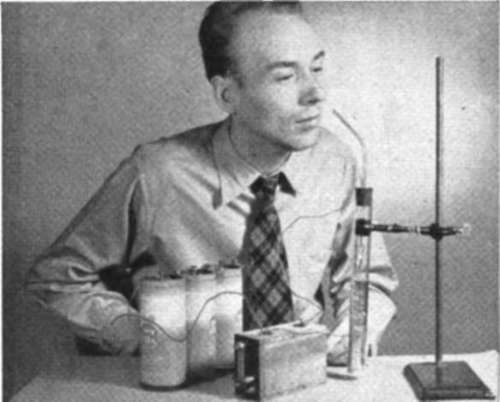
Ozone Generator
Ozone, a form of oxygen that smells liks weak chlorine, may be easily generated with the spark coil. Coat the outside of a glass tube with tin foil, as shown, and connect this to one secondary terminal. Connect the other secondary to a piece of tin foil inside the tube. Stop up the tube bottom, and put a one-hole stopper with a smelling tube in the upper end. Current will cause a pale violet discharge, changing some oxgyen of the air into its allotropic form of ozone.
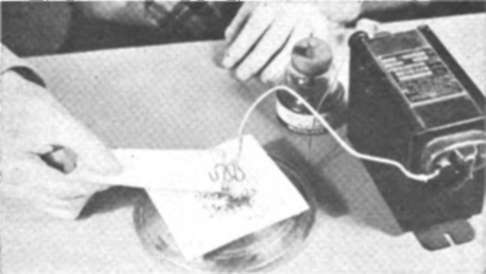
ELECTRO-COATING, as in sandpaper making, is demonstrated with cigarette ashes on a piece of paper. Set the paper on a metal plate connected to one secondary terminal of the coil or transformer. Bend the other secondary wire to resemble a grid, and hold it over the ashes just beyond sparking distance. The ashes will dance around when current is turned on. By holding another piece of paper covered with glue over the ashes, some of the ashes will jump up and be embedded in the glue.
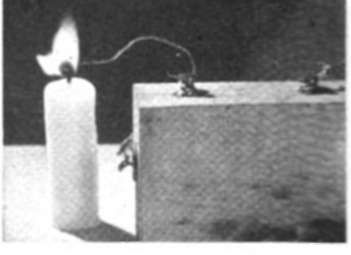
Invisible Discharge
Lead a wire from the high-potential terminal of your spark coil to a candle flame, and the flame will be blown mysteriously when current is on. The cause of this is accumulated electricity of such high intensity at one terminal that some escapes right off the point in the form of electrified air particles. To prevent such leakage, the terminals of most high-potential generators and machines are ball-shaped instead of pointed.
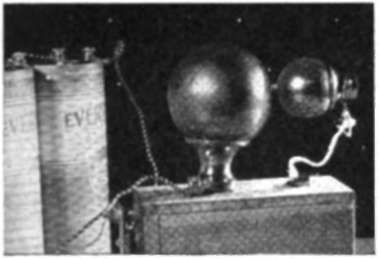
ball terminals connected to the secondary wires will produce only a short, thin spark, compared with that obtained from needle-sharp terminals. For with a ball, the current is spread over a large surface and lacks concentration such as occurs at a needle point. Keep increasing the size of the balls and the spark that it will be possible to produce with keep getting shorter and heavier, until practically no spark can be induced to jump the gap.
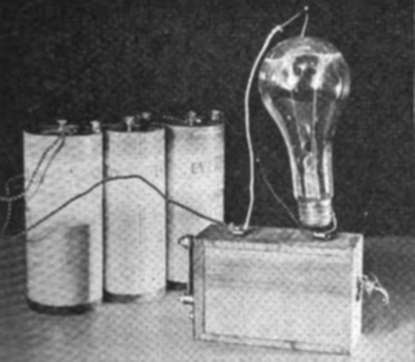
a fluorescent-light effect may be demonstrated by connecting one high-tension wire to a cap of tin foil glued over a burned-out lamp bulb, as shown, and the other to both terminals at the bulb base. Streamers of violet-colored electric discharge-miniature bolts of lightning-will jump between the bulb filament and the tin foil when the current is turned on.
Lightning Arrester
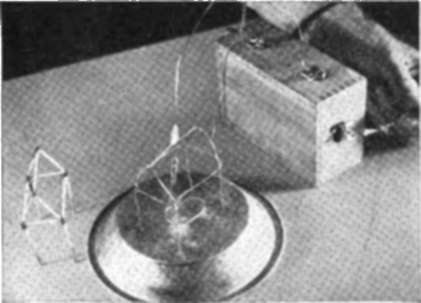
Build wire and wood houses, as shown, and direct "lightning bolts" at them in turn. A match supported head-up in the metal house is protected by the wire, which leads the high-tension current away. But in the wooden house, the spark strikes the match and ignites it, setting fire to the house. The test shows how buildings with metal frames are safer in electrical storms. The more "grounded" metal that surrounds you, the safer you are.
glass conducts electricity poorly, yet heat the tip of a glass rod very hot and hold it just below your spark gap, and your spark will jump twice as far as usual. Remove the rod and the spark stops. Let the rod cool and it will have no effect. The reaction comes because heat ionizes the air in the spark gap, improving its conductivity to the point where a much longer electrical jump is made possible. This little experiment makes a good stunt for mystifying your friends.
Five Stunts With
Simple Meter Is Made Of Coil And Compass
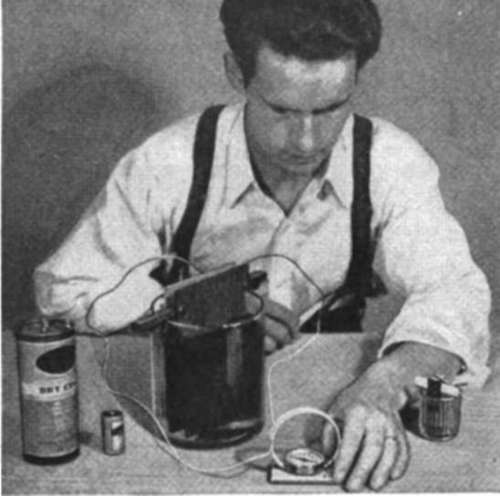
Wind a dozen turns of insulated wire around a cardboard ring, insert a small compass, and you have a handy meter for volts or amperes. A pencil sharpened at both ends and inserted in series with the circuit, as shown at bottom of opposite page, will form a resistance of graphite to raise the voltage range. To increase the range for amperes, instead, a parallel connection or shunt by-passes the meter. At left it is demonstrating the surprising fact that the size of a wet or dry cell has nothing to do with its voltage, as shown by the compass needle's deflec-tion. However, big cells give higher amper-age, and last longer.
Tiny Homemade Cell Shows How Electric Motors Work
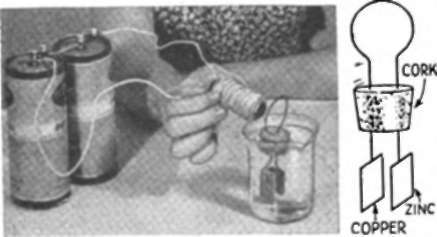
Make a loop of copper wire, about two inches in diameter. Pass the ends through a large, flat cork and solder them to small squares of zinc and copper, respectively. When this tiny electric cell is floated in a tumblerful of dilute sulphuric acid, current flows through the loop and sets up a weak magnetic field. Bring an electromagnet near, and the coil will align itself and slip over it.
Reverse the battery connections of the electromagnet and the loop backs off, turns around to present its opposite fare, and slips on again. Electric motors apply the same principle.
It's Easy To Magnetize Small Pieces Of Steel
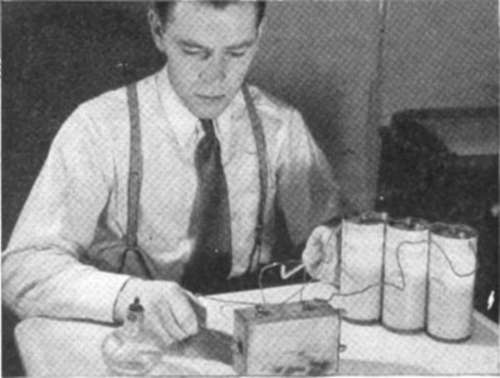
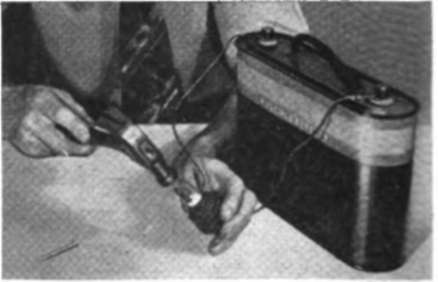
Screw drivers, scissors, and compass needles are easy to magnetize permanently. Wrap fifty turns of bell wire around a cardboard tube of about half-inch diameter. Connect this improvised solenoid, or core-less magnet, to several dry cells. To magnetize an object, simply insert it in the tube for a few seconds while the current is on, meanwhile tapping it with a hammer. This helps the molecules of steel to disentangle themselves and line up in one direction, giving the object its magnetism. Soft iron cannot be used for permanent magnets.
Electric Currents. Changing Circuit Gives Different Heat Effect
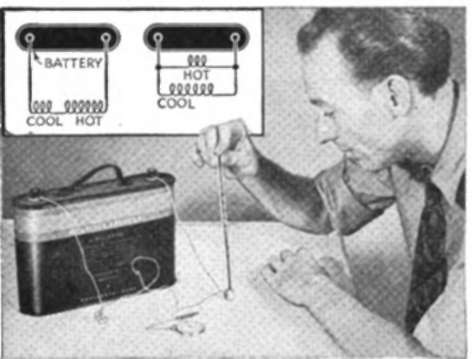
To several dry cells, connect in series two coils of fine insulated wire, one of fifty turns and the other of 100 turns. Place a chemical-type thermometer within each coil and read its temperature after current has been flowing exactly one minute. The 100-turn coil becomes the hotter. Rearrange the coils in parallel, repeat the tests, and you will find that with this circuit the 100-turn coil is the cooler one!
Continue to:


My Books

