


Home Experiments
Description
This section is from the book "Boy's Fun Book Of Things To Make And Do", by Grosset & Dunlap Publishers. Also see: The Pocket Dangerous Book for Boys: Things to Do.
Home Experiments
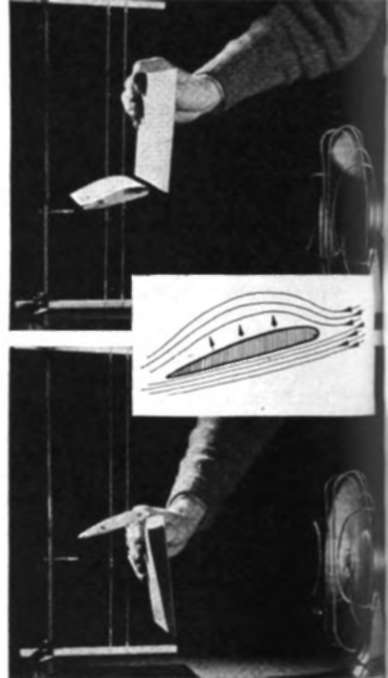
Make this airfoil by covering a cardboard-and-dowel frame with paper. Holes arc needed in the paper to enable the airfoil to move freely along the guide wires as pictured in the photographs above. Stops on the wires cause the airfoil to rest normally just a little below the center of the slip stream from the fan. To show that the airfoil gets more lift from the partial vacuum above the wing than from the air stream under it, hold a strip of cardboard under the leading edge so that only the under surface is exposed to the breeze of the fan. The airfoil will rise a little. Then make a second test 'by holding the cardboard in such a way that the fan blows only above the airfoil, which now rises much higher.
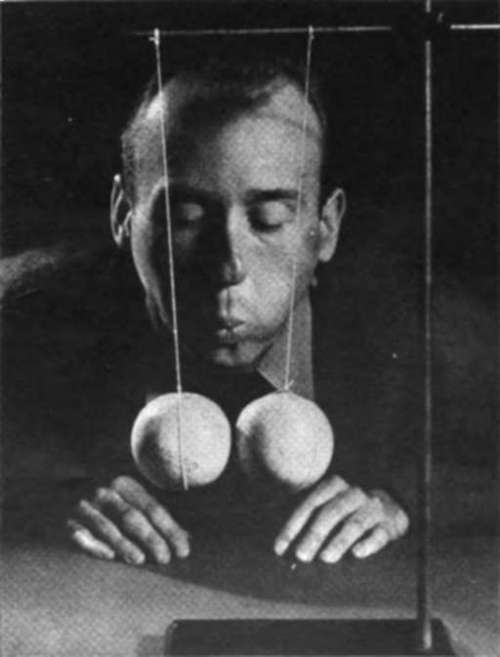
AN AIR STREAM directed in the space be-tween two freely suspended oranges will result in lowered air pressure in this area. The outside air pressure will thereupon force the two oranges together. Suspend the oranges so that they are about 11/2" apart when hanging at rest.
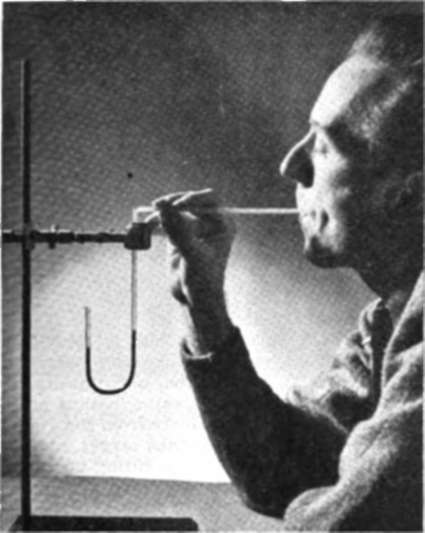
A manometer, a device used for measuring gas pressure, can be made by partly filling a bent glass tube with colored water. The level in both sides is normally the same, but when you blow through another tube squarely across one open end of the manometer, the water rises in that leg, showing that the air pressure oh that side is reduced. As you blow harder, increasing the speed of the air flow, the water rises higher. Similar manometers are used in determining pressures on the various parts of airplane wing surfaces and on the wings of test models. Atomizers work on the same principle.
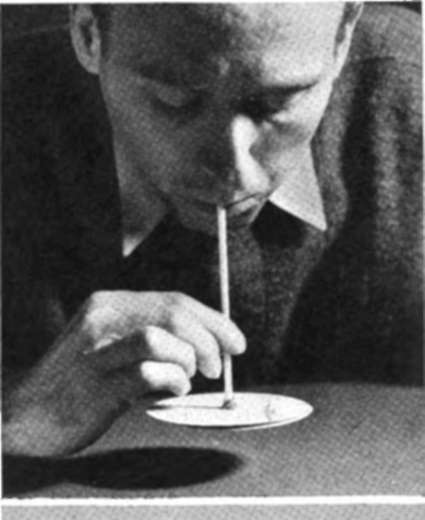
Cut Two disks of cardboard about 4" in diameter. Make a small hole in the center of one and seal the end of a drinking straw over the hole with sealing wax. Push a pin through the center of the other disk. Hold the first disk about 1/2" over the other with the pin sticking up into the straw. Blow hard through the straw, and the lower disk will jump up to the other. The harder you blow, the more firmly the disks stick together, since the air rushing between them reduces internal pressure while external pressure remains the same.
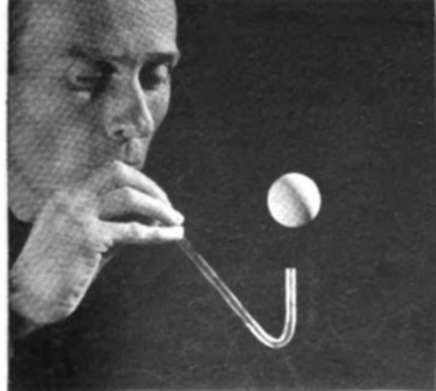
A table-tennis ball bounces up and down if supported on an air stream, but it won't fall to one side. As it tends to do so, the air stream creates a low-pressure area on the opposite side, and atmospheric pressure moves it back.
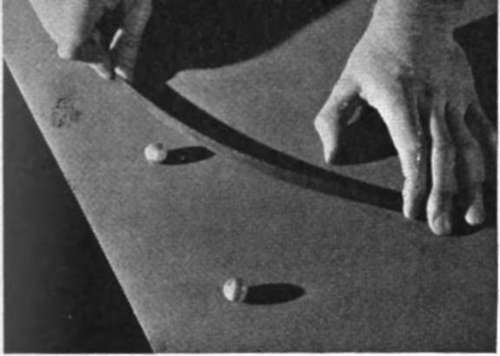
Artillery Fire
Computing the trajectory or path of a shell Is complicated work for an artillery officer, but you can demonstrate the principle on your bridge table with two marbles and a hacksaw blade. Flip the blade as shown above, and the two marbles will shoot off the table, the one closer to the stationary end of the blade a short distance, the other much farther-yet you can tell by the simultaneous clicks that both hit the floor the same instant This seeming contradiction is due to the constant pull of gravity, which exerts the same force regardless of the motion of the object, even though it may have the speed of a bullet. The instant a bullet leaves the gun, gravity attracts it to the earth. One fired horizontally will hit level ground at the same instant as a bullet dropped simultaneously from the gun muzzle. In order to hit a distant target, artillerymen compensate for this by tilting up the muzzle.
THE MOTION OF A PENDULUM is produced by the constant acceleration of gravity. The time of each swing is directly proportionate to the square root of the length of the pendulum. To prove this, suspend a marble on a string and set it swinging. Time its swings with a watch. You will find that to make it swing in half the time, you must shorten the length of the string not to half, but to one fourth that of the original.
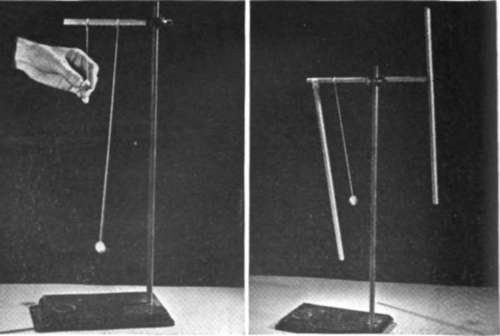
A SUSPENDED ROD is called a compound pendulum, for it acts like a series of weights strung end to end. Suspend a dowel from one end alongside a marble and adjust the string on the latter until both swing at the same rate. The string will be about two thirds the length of the dowel. Mark this point-the center of oscillation-on a dowel of like length, insert a pin, and suspend it alongside the others. All three pendulums will swing in unison.
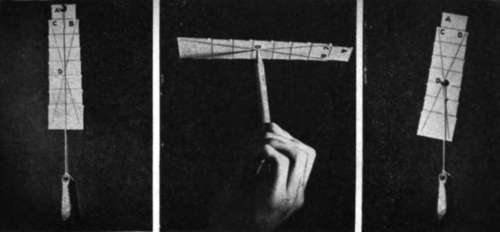
The Leaning Tower Of Pisa doesn't fall because its center of gravity is low. To show this, hang a cardboard cutout from a point B near the top. From there hang a weighted cord and mark its line on the model. Rehang from another point C and mark similarly. The intersection D is the center of gravity, as can be shown by hanging the cutout from point A (left, above).
If the lines are accurate, the model can be balanced at D on a pencil, as in the center photo above. If the cutout is pivoted at D and the plumb line also suspended from this point, the model may be tilted until the cord coincides with either pencil line without toppling over, as shown at the right. Because its base is proportionately heavier than that of the model, the Tower of Pisa could lean much further without falling.
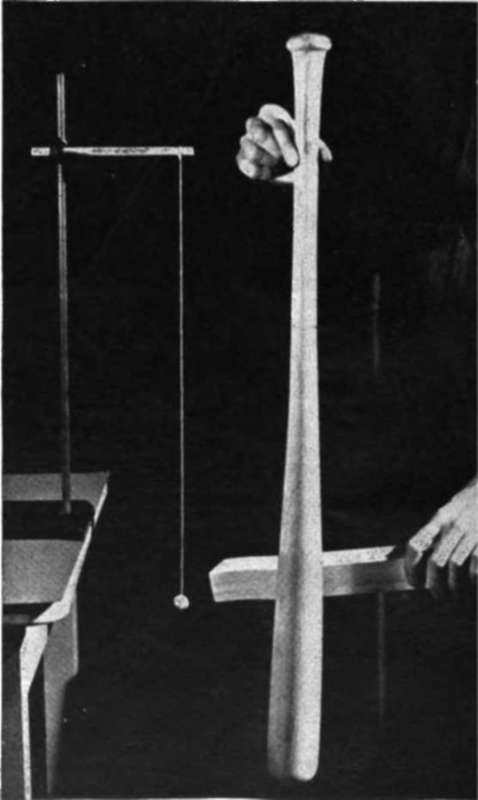
With "BATTER UP!" Babe Ruth applied physics to every home run, for a swinging bat is a compound pendulum, and its center of oscillation is also its center of percussion. This is the point of most effective drive, and the one which imparts the least jar, with the least likelihood of splitting the bat. It can be located by allowing the bat to swing free 6" from the grip end and synchronizing the swing of a marble with it. The point on the bat opposite the marble is the center of percussion. Tapped there, the bat swings freely; struck elsewhere, it shudders and stings your hand. This same law of physics is applied in many hand tools, such as hammers and axes, and in machinery. For instance, if an ax handle is too long, the center of percussion may not be in its head, but farther up, in the handle. Such an ax shudders, and the handle may break.
Continue to:


My Books

