


Beetle Traps From Old Tin Cans
Description
This section is from the book "Boy's Fun Book Of Things To Make And Do", by Grosset & Dunlap Publishers. Also see: The Pocket Dangerous Book for Boys: Things to Do.
Beetle Traps From Old Tin Cans
THE depredations committed by Japanese beetles have forcibly brought home to thousands of gardeners the menace which these winged pests present during the summer season.
For combating them, a strong offensive is the best defense, and the home owner who builds and sets up several of these traps will have gone far toward protecting his plants and lawn. Each trap will attract and catch beetles within an area of several hundred square feet.
The body of the trap is a 1-lb. coffee can having a bayonet-lock top. Punch or drill four groups of 3/16" holes in the side, and twelve similar holes in the bottom. Cut a 2 3/4" hole in the lid. Into this solder a 51/2" tin funnel from which the spout has been removed. Punch four equally spaced 1/4" holes close to the rolled edge of the funnel to receive the baffle tabs.
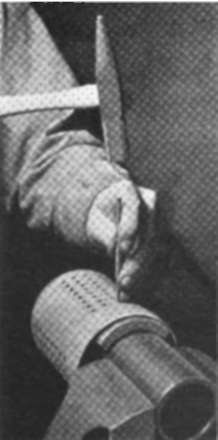
After cutting the two baffles from scrap tin, which may be obtained from tin cans, bend each at a right angle along its center line. Cut out the pattern for the rain guard and solder it along the seam to form a cone 25/8" across at its base. Bend the small hook to shape from stiff wire.
The bait bottle is a 1-oz. bottle of the round, wide-mouth type. Make a 1/2" hole in its cork and insert two folded kerosene-lamp wicks, allowing them to project about 1/4"- A 1-oz. bottle of geraniol, the bait used, can be bought at any garden supply store and should last the entire season.
Paint all parts of the trap a bright yellow. When dry, assemble as shown and hang in a sunny spot not too near shrubs or trees. Empty occasionally, burning the trapped beetles.
Indian Motifs Are Incorporated In Distinctive Weather Vane
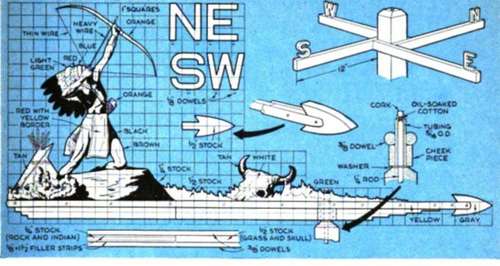
If you treat him well, the Indian chief on this vane will reciprocate by shooting holes in the clouds when your backyard garden needs rain and by frightening the clouds away when you are entertaining outdoors.
The figure, the rock on which it is kneeling, and the sagebrush and tepee behind are jigsawed from 1/4" stock, preferably plywood. Use 1/2" material for the grass and skull in the foreground, as well as for the arrowhead at the front of the vane. Two lengths of 3/8" dowel, flattened on one side, extend back from this arrowhead along the vane. Use 1/8" filler strips as shown.
Paint the vane-the colors indicated make an effective combination-and mount it as shown. Cut the arms and letters from 1/2" stock and nail to the pole.
Continue to:


My Books

