


An Expert Shows How To Play Table Tennis
Description
This section is from the book "Boy's Fun Book Of Things To Make And Do", by Grosset & Dunlap Publishers. Also see: The Pocket Dangerous Book for Boys: Things to Do.
An Expert Shows How To Play Table Tennis
IF YOU want to have a lot of fun at little expense, and become reasonably skillful at one of the fastest sports in the world in a comparatively short time, table tennis is your game. Of all the bat-and-ball games, it is probably the one in which the beginner can have fun most quickly without spending much money..
Table tennis is no parlor diversion. It is one of the most spectacular games yet invented, with an international organization to which 25 nations are affiliated, holding annual world championship matches regularly before the war. But there is scarcely a home in all the land where it cannot be played by practically anyone strong enough to stand up and swing a five-ounce bat.

The accompanying photographs were posed by Louis Pagliaro, one of the leading: American players. These and the diagrams, the latter worked out with Pagliaros assistance, should be studied carefully.
The Equipment You Will Need, Besides The Block
Louis Pagliaro, table-tennis ace, demonstrates the defensive block shot he recommends as practice for beginners. Using the backhand side of the bat at waist height, meet the ball with a gentle forward push. These photographs were made by Robert Smith.
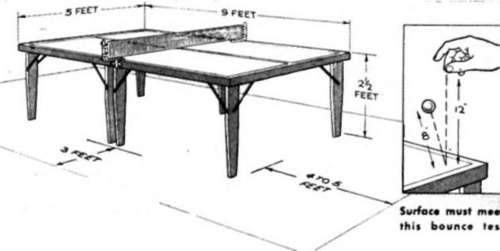
Table
Under U.S.T.T.A. rules, the official table is nine by five feet, with its top 21/2 feet above the floor. The playing surface is of dark color, with a 3/4 -inch white line along each edge and a 1/8-inch white line down the middle for doubles. The net is six feet long, supported by vertical posts set six inches out from the sides of the table, with its top six inches above the surface. The free space indicated around the table in the drawing .is the minimum for satisfactory play. If possible, more space should be provided.
Table and net, is a paddle and a ball. You probably have some rubber-soled shoes about the house and you can wear any clothing you like. Colored clothes are better. The ball is hard to see against white.
The bat and ball you must buy. The standard bat (you can call it a racket if you like) will cost as little as $1.25 and no more than $2.50. The ball, also standard, is of celluloid. The best balls cost no more than 20c each and are good for 50 to 100 games.
The table is more expensive if you buy one. If you desire, you can make one yourself. The cheapest regulation table costs about $20 or $25. But if you can't buy one or make one don't let that stop you. You may not have room for a regulation table, anyhow. If not, the dining-room or kitchen table will do for a starter. You can buy the net and brackets for $2.50.
Anyone who decides to make a table, or have one built, should consult the United States Table Tennis Association, 34 South 17th Street, Philadelphia. Anyone planning to take up the game should provide himself with a copy of the Laws of Table Tennis and study them. They can be obtained from the same address.
You can set up your table in spare room, attic, basement, on the porch, in the yard or nearly anywhere. All you need is four or five feet behind each end and about three feet on either side. A single light over the center of the table will do, (CONTINUED)
Grips
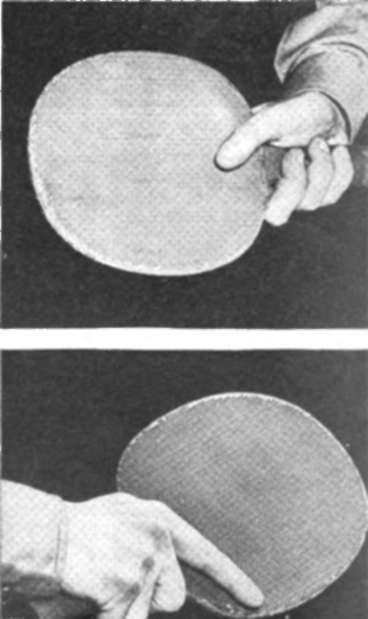
The so-called tennis grip, which is illustrated in two views at the right, is preferred by most professionals as an all-purpose grip. The handle of the bat is held naturally in the hand, with the thumb extended on one side of the blade and the forefinger on the other. Beginners are warned not to cultivate the old-fashioned "penholder" grip pictured in the photograph below

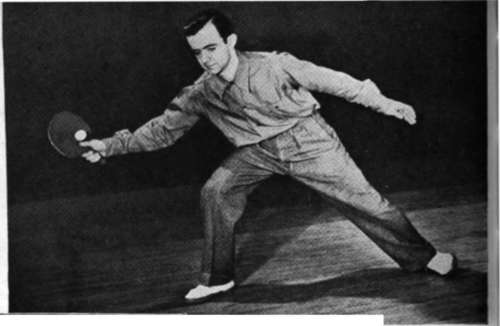
Used for giving added bockspin to the ball, this stroke is executed by stepping back with the right foot so that it is in line with the ball. Bend the right knee slightly and bring the bat back about half way, as shown above. The stroke is made with a downward motion of the arm, the weight shifting to the other foot. (See photo at left).
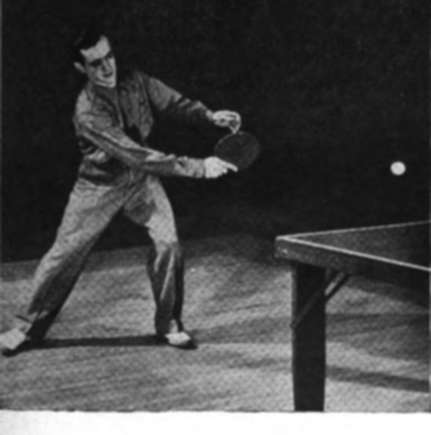
Backhand Chop
Bring the racket bock to the line of the left shoulder, and bend the left knee in fine with the ball. As the ball begins to drop after the bounce, swing the bat into it with a straight motion to the side and down. The offensive stroke is taken when the ball is about six inches from the racket. The successive stages are illustrated below
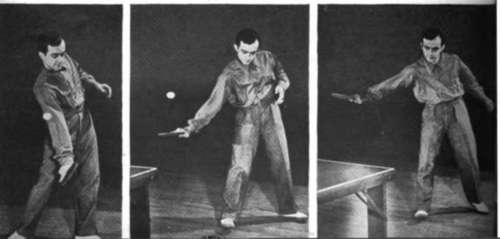

Forehand Drive
In executing this drive, turn sidewise in the direction in which the ball is coming at you. The left foot is put slightly ahead of the right and you assume a half crouch with the arm bent at the elbow. As the ball bounces on the table, bring the racket back and hit the ball with a rotary motion as illustrated. The bottom surface of the bat brushes the top of the ball, giving it the top spin
Backhand Drive
The backhand drive, illustrated below, is just the reverse of the forehand drive. This time the right foot is forward and the racket is held in front of the body as shown. By holding the racket at an angle and stroking the top of the ball, top spin is given. Beginners will work their way easily into strokes like this after mastering the simpler block shot and learning to control speed and direction

For backhand shots, the body is turned to the left of the ball's course, with the right foot forward. For forehand shots, the body faces right, left foot is forward.


Continue to:


My Books

