


Girders With Plates
Description
This section is from the book "Notes On Building Construction", by Henry Fidler. Also available from Amazon: Notes on building construction.
Girders With Plates
Girders With Cast-Iron Plates
Fig. 254 is the sectional elevation of a floor formed as follows : -
Wrought-iron rolled or built-up girders, G, span the room at from 10 to 15 feet central intervals.
Running at right angles to these, and resting upon them, are rolled joists, J J, about three feet apart. Upon the upper flanges of these joists are laid cast-iron plates shown in section at C, the joints being so shaped as to overlap one another. The under side of these plates may be cast to a pattern, so as to form an ornamental ceiling.
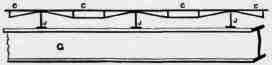
Fig. 254.
Another row of cast-iron plates may, if required, be placed on the lower flanges of J J. The space between the two sets of plates may be left hollow so as to contain a stratum of air for coolness, or it may be filled with deafening composition, slag wool, or concrete.
The cast-iron plates are, of course, an objection to this system.
Girders With Wrought-Iron Plates
Some years ago Sir W. Fairbairn recommended fireproof floors constructed with wrought-iron plates of arched form riveted to the lower flanges of the girders, and filled up to the level of the floor with concrete, thus forming concrete arches of some 10 or 12 feet span with a wrought-iron lining to the soffit, supported at intervals by T iron ribs. For smaller spans Mallet's buckled plates (see Part III.) have been used, their edges being riveted to the lower flanges of the girders upon which they are laid.
Continue to:


My Books

