


The Amount Of Schooling A Young Horse May Be Given
Description
This section is from the book "Training Young Horses To Jump", by Geoffrey Brooke. Also available from Amazon: Training Young Horses To Jump.
The Amount Of Schooling A Young Horse May Be Given
If the reader schools on the lines I have suggested he can let his horse jump four days a week without any fear of his becoming stale. The action of jumping muscles a horse and helps to balance him. Poor Dugdale, late of the 16th Lancers, whose sad death took place last December near Rome, in a report he sent home, wrote: "It is impossible to lay down any rule about the rate of progression; at Pinerolo it seems extraordinarily slow, but the result is that all horses jump exceptionally well. Start with a bar on the ground, go over this at all paces until the horse has absolute confidence, and then raise the bar a notch at a time. For the first six weeks at Pinerolo the bar was never raised more than one foot from the ground. The Italian motto is 'Patience and Progression.' The final result is that no horse ever refuses or rushes."
This extract gives some idea of the pains that Continental riders take to reach perfection in training their horses.
A Reasonable Period Required For Schooling A Young Horse Bought In June.
July
Commence with careful conditioning. Mouthing, balancing, quiet riding. This, of course, will be continued during the training.
August
Free or dismounted jumping. If the horse is fit and in the hands of a competent horseman, mounted schooling is preferable in my opinion, but only under these conditions, and carried out on the lines previously suggested. During this month a Riding School will be found most useful as the going outside will be unsuitable for schooling.
September
Further advanced schooling, the obstacles being varied as much as possible. Opening gates. Should the ground permit, small obstacles, ditches, banks, and natural fences may be jumped. The horse requires daily at least two hours slow work to condition him.
October
Schooling with other horses out of doors. Jumping faster. Shown hounds. Dogs or goats kept in the stable will generally make young horses accustomed to hounds and prevent them kicking. With an excitable young horse, it is preferable that he should not be galloped the first few times with hounds. We want him to like hounds, but not to go mad with them. When he has been out several times, at a suitable opportunity he should be allowed to extend himself right out, after which in all probability he will come back willingly to your hand again. The rider, having careful regard to the temperament of his horse, must use his own discretion in introducing him to hounds.
November
Two hours with hounds is quite sufficient for a young horse (5 years old), and the meet should be handy.
Now we will assume that our rider has got his horse reasonably accustomed to hounds during October cubbing, and an early frost has to some extent cleared the fences. He has previously, on several occasions, followed at the tail of the field, jumping the gaps and fences slowly and deliberately. The time has come for the youngster to be allowed to slip along in a hunt. It is no longer desired to hold him back, nor should it be necessary with his previous training. The young horse must get well away with hounds, so that he sees and hears them. He will soon be keen to keep with them. The music and sight of hounds redoubles a young horse's confidence in himself. A good scent makes a good fox and a good hunter too. With hounds in front a good fit young horse requires no lead at a strong, forbidding-looking fence. An inherent love to be with the hounds is born in every good horse. One finds it again in his later life, even as a doddering old cripple in a field. The music of hounds will make him prick his ears, snort and trot round the field, forgetting his old age, perhaps only remembering his first hunt with hounds.
But there is more required than a good start, the rider must at times steady his young horse and, whenever possible, save him in this his first hunt.
With a ditch on the near side of a fence leaning towards one, pace is a secondary consideration.
He must look and see the ditch and judge his stride correctly. It is advisable to pick out your place where the edge of the ditch on the take-off side is clearly defined and steady your horse. He has previously been accustomed to having his head free before he reaches the fence, to enable him to look down and correct his stride. He will not forget that lesson now, and the rider will be repaid for the trouble he took in the early schooling. In the same way a young horse should be steadied at open water or rails: it will enable him to get into his proper stride and he will be less likely to slip taking off. At the same time he must be given the office with determination when required. At all fences, but particularly at an upright fence or rails, a good take off is invaluable. It is preferable and safer to jump a large fence with a good take off than a small one where the near side is unsound or slippery. In fact, with horses jumping, as with men, seventy-five per cent, of the difficulty lies in the take off. A young horse may also require to be helped if he is dropping his hind-legs into a ditch by the rider leaning his weight forward on landing. This can easily be done with practice, and may even save a back from being broken. I must conclude with one word of warning.
Though it may not be the rider's fault if he breaks his horse's back, it is if he breaks his horse's heart and rides a youngster to a standstill. We may all have done it, but it is criminal.
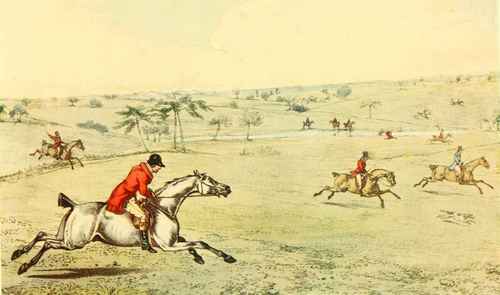
"The Dream Of An Old Meltonian"
No doubt some readers who have struggled through these pages will say, "All this schooling is quite unnecessary. Surely horses have always jumped well enough without all these theories and systems?" But remember there is many a horse that might have been a "top sawyer" if he had not been spoiled when young. Besides, hounds go faster and fences get bigger as we grow older. As a rule the horse is a kind and long-suffering animal, but there are exceptions. Whereas one horse will make it a point of honour to actually catch his rider rather than let him fall, another will give a good buck when he lands to ensure the opposite effect. It is hoped that these suggestions may be found applicable when dealing with the exceptions and aid successful results.
Gloria Finis
Continue to:


My Books

