


Drains
Description
This section is from the book "The Stable Book: Being A Treatise On The Management Of Horses", by John Stewart. Also available from Amazon: The Stable Book.
Drains
These are seldom thought of. But, in some situations, to have a dry and sweet stable, they are absolutely necessary. In short stables, having only four or five horses in a row, underground drains are useful only for draining the foundations. On a stable not exceeding twenty-four or thirty feet in length, sufficient declivity can be obtained on the surface for removing the urine. But in a stable fifty or sixty feet long, a gutter is not so easily procured. The declivity necessary for carrying off the water, raises one end of the stable to an inconvenient height. A drain should be sunk. This may receive the water either from each stall, or from a grating placed near the centre of the stable, which, in the latter case, must slope from each end. Goodwin recommends a cast-iron grating near the centre, or rather toward the entrance of each stall, which should incline a little from all sides. The grate is in four pieces, resting upon ridges of stone, and having the bars so close that the calkins of the shoes can not pass between them. They have something like this at the Veterinary College, the only place in which I remember to have seen anything of the kind. The contrivance answers the purpose very well; it carries off the urine by sunk drains, and at once, and it saves the litter.
The object of this plan is to get rid of the inclination usually given to the floor of the stall. The cost, however, is greater than the mischief it is supposed to prevent.
When the urine is to be saved, it may be carried to the manure-pit, or to a cess-pool outside the stable, and emptied occasionally by a pump. The end of the drain should never be exposed to the air. It ought to have a trap-door, which will open by the pressure of the water, and shut when the water has passed. When this is neglected, cold air rushes through the gratings and blows upon the horses' heels, or noxious vapors arise from the cess-pool.
In some stables there is no contrivance for carrying off* the water. Part is soaked up by the litter, part sinks into the floor and the remainder, which is the most acrimonious, evaporates and mingles with the air. These stables of course are always damp and foul. Their inhabitants are liable to more than their share of disease at all times, and especially when an unhealthy season prevails.
Fig. 2.
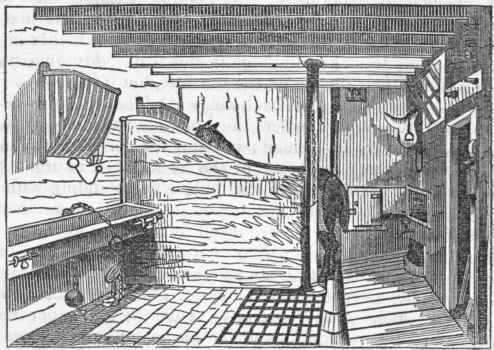
Fig. 2 gives a view of the stable erected by the late Mr. James Donaldson. The breadth excepted, it is a perfect model for a stable of two stalls. One half of the stall floor is laid with brick; the other half is covered by a single slab of freestone, which is grooved longitudinally and transversely, and perforated at each intersection of the grooves. The perforations conduct the urine to an under-ground drain, which can be cleaned in its whole extent by lifting the channel-grating. This seems to be a much better contrivance than the iron-grating, since it is more extensive, less costly, less likely to give or to receive injury, and requiring no declivity on any par of the stall. In other respects this stable is very neat. It has a boiler behind the inside stall; a cupboard, a window well placed, the mangers and travis moveable. It is only twelve feet wide; if copied, the gangway should bo three feet broader. In this cut, the manger is shown too low and the rack too high.
Continue to:


My Books

