


Tuberculosis Of The Horse
Description
This section is from the book "The Horse - Its Treatment In Health And Disease", by J. Wortley Axe. Also available from Amazon: The Horse. Its Treatment In Health And Disease.
Tuberculosis Of The Horse
It was for a long time believed that the horse was refractory to the invasion of tubercle, and the impression still remains that the disease is extremely rare in this animal. Recent enquiries, however, tend to prove that this view is erroneous. The improved methods of investigation which have lately been introduced have enabled the pathologist to demonstrate the existence of the tubercle bacillus in various organs - lungs, liver, etc. - in diseases which were formerly described by other names, as caseous degeneration, lymphadenoma, and induration, or scirrhus. The detection of the tubercle bacillus in morbid deposits in the glands and other structures is, of course, conclusive, and it may also be said that it is essential for correct diagnosis.
Koch's discovery of the tubercle bacillus (fig. 221) established a new era in the history of consumption and other forms of tuberculous disease.
It is now admitted that all these affections may properly be classed among the true contagia, depending as they do on the introduction of a specific organism from without.
Experimental evidence leaves no room for doubt that the affection occurs by introduction of the germs into the respiratory organs along with inhaled air, and also into the digestive organs with the food.
In the horse, as in most animals, the lungs are more often affected than other organs, and it may be assumed that the most frequent mode of infection is through the respiratory passages. The animal, however, is not exempt from the other mode of infection.
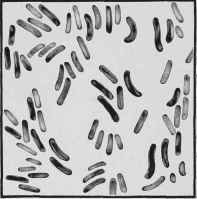
Fig. 221. - Bacillus of Tuberculosis.
Inoculation with tuberculous matter causes, in most cases, tuberculosis by the introduction of the virus into the blood.
Symptoms
Even in cases where signs of disease are present there is nothing to be discovered which is positively indicative of tuberculous deposit - cough, difficulty of breathing under exertion, irregular appetite, and emaciation are all signs of tuberculosis, but these may all be due to other affections, and it is not until an opportunity for microscopic examination of expectorated matter or a post-mortem examination occurs that the existence of the tubercle is as a rule discovered.
Continue to:


My Books

