


Predisposing Causes
Description
This section is from the book "The Horse - Its Treatment In Health And Disease", by J. Wortley Axe. Also available from Amazon: The Horse. Its Treatment In Health And Disease.
Predisposing Causes
For various reasons some bones are more liable to fracture than others, and this represents their predisposition.
In looking over the body it is not difficult to see that certain bones are much more exposed to collision and to external violence by virtue of their position than others Of these the points of the haunch projecting from the quarters afford a striking example. They display a special liability to be brought into forcible contact with door-posts while horses are passing into or out of the stable, or through narrow passages, and to receive the first impact of the ground where, as sometimes occurs, their hind-legs slip from under them, and they fall helplessly on their side.
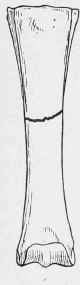


Fig. 326. - Fractures 1, Transverse. 2, Oblique. 3, Longitudinal.
The canons or metacarpal bones, unprotected by muscles, are exposed to the full force of any external violence that may be applied to them, besides which their movements are sharp and forcible, and meet colliding objects with great resistance.
The large pastern also, by virtue of its position, is specially liable to fracture, and in a less degree also the forearm and lower thigh.
Age imparts a state of brittleness to bones which is not found in the young and the adult; hence old animals are more prone to fracture than younger ones.
In early life, before the epiphyses or prominences which are connected with the shafts of bones have become firmly united by ossific union, they are liable to be torn away by muscular contraction, or otherwise forcibly displaced.
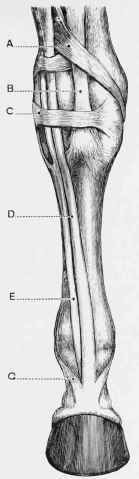
1. Front View.
A, Extensor Metacarpi Obliquus.
B, Extensor Metacarpi Magnus. c, Annular Ligament.
D, Extensor Pedis.
G, Outer Branch of Suspensory Ligament.
The ligaments of the pastern are more fully shown in tig. 356, page 272.
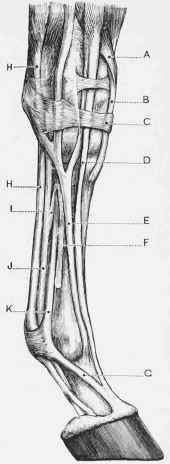
2. Outer Side View.
A, Extensor Metacarpi Obliquus.
B, Extensor Metacarpi Magnus.
C, Annular Ligament.
D, Extensor Pedis.
E, Extensor Suffraginis.
F, Outer Small Metacarpal or Splint Bone.
G, Outer Branch of the Suspensory Ligament. H, Flexor Pedis Perforatus. I, Subcarpal or Check Ligament. J, Flexor Pedis Perforans. K, Suspensory Ligament.
Fig. 327. - Principal Tendons and Ligaments of the Fore Limb.
Structural alterations, the result of disease, by weakening the bone tissue, lessen its power of resistance to ordinary forces, and thereby conduce to fracture.
The navicular bone, after a period of ulceration, breaks beneath the weight thrown upon it in action.
The imperfectly - developed bones of the rickety foal, after bending under the strain imposed upon them, may sooner or later present a partial or complete fracture.
Various other morbid changes, such as cancer, osteo-porosis, melanosis, etc, render bones specially amenable in this direction to causes which they would otherwise resist.
Season of the year, and the nature of the surface over which horses travel, tend to increase the liability or predispose to fracture.
In winter, when the roads are covered with ice, and in towns where horses have to travel over wood pavement or other smooth surfaces made slippery with water, legs, hips, and ribs are in consequence frequently broken.
The exciting causes of fracture are: 1, external violence, such as kicks, collisions, falls, blows, twists, etc.; and 2, muscular contraction.
Violence may operate either directly or indirectly, i.e. it may break the bone to which it is immediately applied, or some other at a distance from it. It sometimes occurs that a horse falling upon the poll, and striking the occipital bone, breaks the sphenoid bone at the base of the brain. Horses fracture the os suffraginis, or long pastern, or even the canon-bone by pitching on the toe while endeavouring to save themselves from a fall, or in jumping or galloping.
Examples of fracture as the effect of muscular contraction are seen in those common accidents which occur to horses while being cast, or in the course of a surgical operation. The violent struggles to free themselves from restraint too commonly give rise to a broken back, or a broken thigh, or the breaking away of one of the epiphyses or bony projections from the shaft of a bone.
Symptoms
To determine the presence of a fracture in the horse is sometimes a very difficult, and may be an impossible task. The parts to be dealt with are large, heavy, and do not lend themselves to that thorough and searching examination which is so capable of being made in the smaller animals. Besides, the excitable and refractory character of the horse greatly interferes with that full control so necessary to a successful diagnosis. Of course we can bring to our aid the restraining influence of chloroform, but even this is not an unmixed good. Whether a horse be cast before its administration, or be allowed to fall while under its influence, there is in both cases the danger of displacing the broken bones and converting a simple into a compound fracture, or causing a troublesome displacement of the broken parts.
Before any such step is taken it is desirable to exhaust all other means at our disposal.
The symptoms exhibited as the result of fracture will vary according to the situation and the purpose which the bone serves.
Fracture of the long bones of the extremities is not generally difficult to diagnose. It may be at the time of its occurrence someone heard a "snap". If displacement result, this would be followed by sudden and acute lameness and an inability to support weight on the broken limb. The parts below the fracture would hang loosely, the toe would sway involuntarily from side to side, or might be directed backwards. Swelling on the region of the fracture and parts below it soon appears, attended with local inflammation and pain.
Continue to:


My Books

